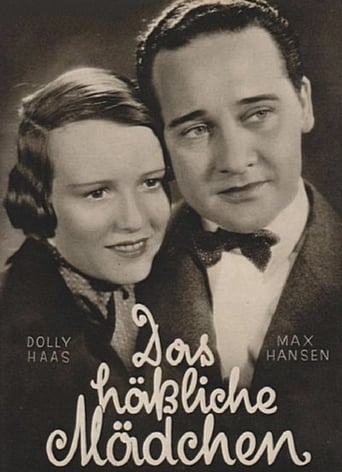
Das häßliche Mädchen (1933)
An unattractive secretary is hired so the men in the office will focus on their work, but comic complications ensue.
- Data di uscita
- 1933-03-17
- TMDB
- 7.5 / 10 (2)
- Durata
- 1 h 12 min
- Generi
- Commedia
- Regista
- Henry Koster
Cast
- Dolly Haas — Lotte
- Max Hansen — Fritz
- Otto Wallburg — Direktor Mönckeberg
- Genia Nikolaieva — Lydia
- Julius Falkenstein — Leschke
- Erich Kestin — Oskar
- Marianne Stanior
- Paul Rehkopf
- Klaus Pohl
- Ernst Behmer
- Josef Peterhans
- Ludwig Rüth
Curiosità
Das häßliche Mädchen is a German comedy film made in early 1933, during the transition from the Weimar Republic to Nazi Germany, and premièred in September that year. It was the first or second film directed by Hermann Kosterlitz, who left Germany before the film was completed and later worked in the United States under the name Henry Koster, and the last German film in which Dolly Haas appeared; she also later emigrated to the US. A Nazi-led riot broke out at the première to protest the male lead, Max Hansen, who was supposedly "too Jewish." The film's representation of the "ugly girl" as an outsider has been described as a metaphorical way to explore the outsider existence of Jews.
Background and reception
Das häßliche Mädchen was filmed at the Avanti Tonfilm studios in Grunewald, Berlin in January–February 1933, the first months of Hitler's term as Reich Chancellor. Between filming and the 8 September première at the Atrium-Theater, the Nazis had begun to define and institute their official policies of anti-Semitism targeting the cinema industry.
Hermann Kosterlitz both directed and co-wrote the script. This was his first or second time directing. Kosterlitz, who was Jewish, had left Germany months before the première, without seeing the final cut. His name was removed from the credits and replaced by an "Aryan" pseudonym, "Hasse Preis". He went to Paris in April, then via Budapest and Vienna to Hollywood in 1936.
The male lead, Max Hansen, was reputed to be part-Jewish and the previous year had performed a comic song implying that Hitler was homosexual; at the opening, in a riot orchestrated by the Nazis, members of the audience attacked him as "too Jewish", shouting "We want German movies! We want German actors!", and he was pelted with tomatoes. Rotten eggs were thrown at the screen.
Dolly Haas was an exclusively comedic actress with an androgynous persona well suited to a film about appearance and the performance of identity; there were rumours about her racial heritage, too, but they were squashed with statements that she came "from a good Aryan family". Upset by the treatment of her co-star, she accepted an invitation to work in England in 1934 and left Germany for good in 1936.
The film did receive praise for its humour, and reviews included phrases such as "pleasant", "amusing" and "full of delightful ideas". The Film-Kurier review noted that there was applause when the film ended, and an ovation for Haas, before she brought out Hansen. During this transitional year, Nazi control over the film industry had yet to be consolidated and practices and attitudes varied.
Leggi su Wikipedia · Testo da Wikipedia, CC BY-SA 4.0. Dati da Wikidata.
Consigliati
- Military Academy 2007 · ★ 6.0
- L'idolo delle donne 1961 · ★ 6.3
- Uno spostato sotto tiro 1999 · ★ 5.9
- Men in the City 2009 · ★ 6.2
- The Manny 2015 · ★ 6.3
- Adventures in Public School 2018 · ★ 6.3
- Class Rank 2017 · ★ 6.9
- Men in the City 2 2011 · ★ 6.3
- Il mattatore di Hollywood 1961 · ★ 6.2
- Moonwalkers 2015 · ★ 6.1
- Adam Sandler: Love You 2024 · ★ 6.1
- Gli sgangheroni 1992 · ★ 6.1