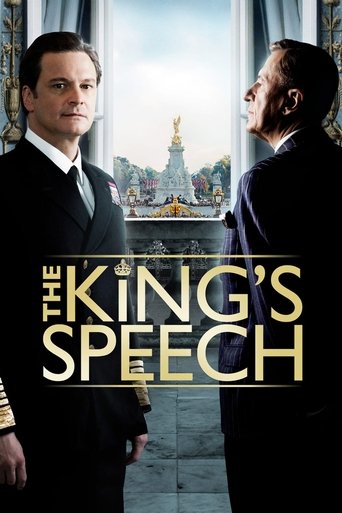
The King's Speech (2010)
Find your voice.
The King's Speech tells the story of the man who became King George VI, the father of Queen Elizabeth II. After his brother abdicates, George ('Bertie') reluctantly assumes the throne. Plagued by a dreaded stutter and considered unfit to be king, Bertie engages the help of an unorthodox speech therapist named Lionel Logue. Through a set of unexpected techniques, and as a result of an unlikely friendship, Bertie is able to find his voice and boldly lead the country into war.
- Date of release
- 2010-11-26
- TMDB
- 7.7 / 10 (9675)
- Runtime
- 1h 58m
- Genres
- Drama, History
- Director
- Tom Hooper
Casting
- Colin Firth — King George VI
- Geoffrey Rush — Lionel Logue
- Helena Bonham Carter — Queen Elizabeth
- Guy Pearce — King Edward VIII
- Timothy Spall — Winston Churchill
- Michael Gambon — King George V
- Jennifer Ehle — Myrtle Logue
- Derek Jacobi — Archbishop Cosmo Lang
- Freya Wilson — Princess Elizabeth
- Ramona Marquez — Princess Margaret
- Richard Dixon — Private Secretary
- Robert Portal — Equerry
Interesting facts
- Box office: $424M
- Filmed in: London, Odsal Stadium, Halton House, Portland Place, Battersea Power Station, Elland Road and 14 more
- Awards: 9 · Nominations: 17. Including: Academy Award for Best Picture; Academy Award for Best Actor; Academy Award for Best Director; Academy Award for Best Writing, Original Screenplay
The King's Speech is a 2010 historical drama film directed by Tom Hooper and written by David Seidler. Colin Firth plays the future King George VI who, to cope with a stammer, sees Lionel Logue, an Australian speech and language therapist played by Geoffrey Rush. The men become friends as they work together, and after his brother abdicates the throne, the new king relies on Logue to help him make his first wartime radio broadcast upon Britain's declaration of war on Germany in 1939.
Production
As a child, David Seidler developed a stammer, which he believes was caused by the emotional trauma of World War II and the murder of his grandparents during the Holocaust. King George VI's success in overcoming his stammer inspired the young Seidler, "Here was a stutterer who was a king and had to give radio speeches where everyone was listening to every syllable he uttered, and yet did so with passion and intensity." When Seidler became an adul…
The Queen Mother died in 2002. Three years later, Seidler returned to the story during a bout of creative work inspired by a recovery from cancer. His research, including a chance encounter with an uncle whom Logue had treated, indicated he used mechanical breathing exercises combined with psychological counselling to probe the underlying causes of the condition. Thus prepared, Seidler imagined the sessions.
In 2005 a small production company in London, received the script. The owner Joan Lane started talking with Simon Egan and Gareth Unwin of Bedlam Productions, and they invited Seidler to London to rewrite the play again, this time for the screen.
Instead of trying to contact Geoffrey Rush's agent, Lane asked an Australian staff member to hand-deliver the script to Rush's house, not far away from hers in Melbourne. Unwin reports that he received a four-page e-mail from Rush's manager admonishing them for the breach of etiquette, but ending with an invitation to discuss the project further.
The production team learned – some nine weeks prior to the start of filming – of a diary containing Logue's original notes on his treatment of the Duke, which was in the process of being turned into a non-fiction book by Logue's grandson Mark and journalist Peter Conradi, titled The King's Speech: How One Man Saved the British Monarchy.
Read on Wikipedia · Text from Wikipedia, CC BY-SA 4.0. Data from Wikidata.
Recommended
- Victoria & Abdul 2017 · ★ 6.9
- Darkest Hour 2017 · ★ 7.4
- The Queen 2006 · ★ 6.9
- Spencer 2021 · ★ 6.7
- The Current War 2018 · ★ 6.7
- King Lear 2018 · ★ 6.0
- All Is True 2018 · ★ 6.0
- Six Minutes to Midnight 2020 · ★ 6.2
- Giant 2026 · ★ 6.8
- The Elephant Man 1980 · ★ 8.1
- Oranges and Sunshine 2010 · ★ 6.9
- Gaslight 1944 · ★ 7.5