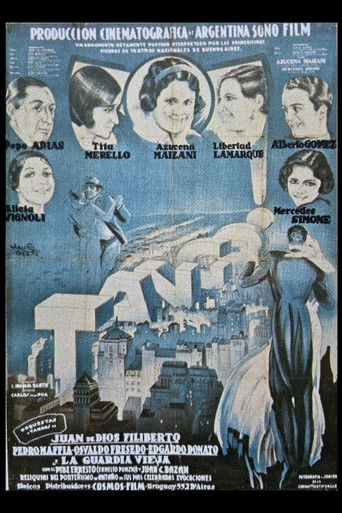
¡Tango! (1933)
¡Tango! follows a formula established by Carlos Gardel with films such as Luces de Buenos Aires (The Lights of Buenos Aires, 1931) in which a melodramatic story is interspersed with tango songs. However, the film had less dialog and more music, making it more like a musical revue. This format would be copied by many subsequent films. The plot is derived from tango songs. Many of these songs tell of the seduction of an innocent slum girl by a rich man who promises her a glamorous life, but who abandons her when her looks fade. The stylized and sentimental plot of ¡Tango! revolves around a young man who is abandoned by his girlfriend for an older rich man and is heartbroken. The film follows his misfortunes.
- Date of release
- 1933-04-26
- TMDB
- 8.0 / 10 (1)
- Runtime
- 1h 19m
- Genres
- Drama, Music
- Director
- Luis Moglia Barth
Casting
- Libertad Lamarque — Elena
- Pepe Arias — Pepe el bonito
- Tita Merello — Tita
- Alberto Gómez — Alberto
- Alicia Vignoli — Alicia
- Luis Sandrini — Berretín
- Meneca Taihiada — Mecha
- Juan Sarcione — Malandra
- Azucena Maizani — Herself
- Mercedes Simone — Herself
- El Cachafaz
- Juan de Dios Filiberto
Interesting facts
¡Tango! is a 1933 Argentine musical romance film, the first film to be made in Argentina using optical sound technology Many existing stars of the Argentine stage and radio appeared in the film, but its success was limited due to poor sound quality and weak acting. ¡Tango! established a formula that would be used by many subsequent tango films.
Production
The 80-minute black and white film was directed by Luis Moglia Barth, who co-wrote the script with Carlos de la Pua.
It was Argentina Sono Film's first production.
The film showed strong Hollywood influence in its cinematic techniques.
It was the first optical sound feature film to be produced in Argentina, at Argentina Sono Film's new optical sound studio.
The stars included the singer and actress Libertad Lamarque, the stage actor Pepe Arias, the singer Azucena Maizani and the comedian Tita Merello, all well-known theatre or tango performers.
Read on Wikipedia · Text from Wikipedia, CC BY-SA 4.0. Data from Wikidata.
Recommended
- Havana Blues 2005 · ★ 6.4
- Hounddog 2008 · ★ 6.5
- Take the Lead 2006 · ★ 6.9
- Beats 2019 · ★ 6.7
- Grace Unplugged 2013 · ★ 6.0
- Clika 2026 · ★ 8.3
- Mo' Better Blues 1990 · ★ 6.5
- Grease Live 2016 · ★ 7.1
- Band Together 2025 · ★ 7.4
- Battle of the Year 2013 · ★ 6.8
- Honey: Rise Up and Dance 2018 · ★ 6.9
- Coda 2020 · ★ 6.1