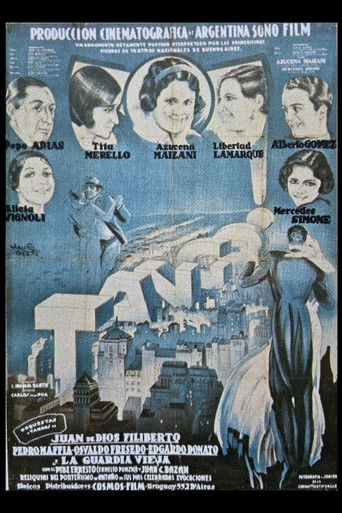
¡Tango! (1933)
¡Tango! follows a formula established by Carlos Gardel with films such as Luces de Buenos Aires (The Lights of Buenos Aires, 1931) in which a melodramatic story is interspersed with tango songs. However, the film had less dialog and more music, making it more like a musical revue. This format would be copied by many subsequent films. The plot is derived from tango songs. Many of these songs tell of the seduction of an innocent slum girl by a rich man who promises her a glamorous life, but who abandons her when her looks fade. The stylized and sentimental plot of ¡Tango! revolves around a young man who is abandoned by his girlfriend for an older rich man and is heartbroken. The film follows his misfortunes.
- Date de sortie
- 1933-04-26
- TMDB
- 8.0 / 10 (1)
- Durée
- 1 h 19 min
- Genres
- Drame, Musique
- Réalisateur
- Luis Moglia Barth
Distribution
- Libertad Lamarque — Elena
- Pepe Arias — Pepe el bonito
- Tita Merello — Tita
- Alberto Gómez — Alberto
- Alicia Vignoli — Alicia
- Luis Sandrini — Berretín
- Meneca Taihiada — Mecha
- Juan Sarcione — Malandra
- Azucena Maizani — Herself
- Mercedes Simone — Herself
- El Cachafaz
- Juan de Dios Filiberto
Anecdotes
¡Tango! est un film argentin réalisé par Luis Moglia Barth et sorti en 1933. Il est considéré comme le premier long métrage parlant argentin, utilisant le procédé du son optique. De nombreuses vedettes de la scène et de la radio font leur apparition dans le film, qui n'a pas eu un grand succès mais qui a établi une formule qui a été utilisée ultérieurement par de nombreux films sur le tango.
Lire sur Wikipédia · Texte de Wikipédia, CC BY-SA 4.0. Données de Wikidata.
Recommandés
- Havana Blues 2005 · ★ 6.4
- Hounddog 2008 · ★ 6.5
- Dance with me 2006 · ★ 6.9
- Grace Unplugged 2013 · ★ 6.0
- Clika 2026 · ★ 8.3
- Noces de sang 1981 · ★ 6.6
- CATO 2021 · ★ 8.5
- Band Together 2025 · ★ 7.4
- Battle of the Year 2013 · ★ 6.8
- Hello 2022 · ★ 6.3
- Beats 2019 · ★ 6.7
- Mo' Better Blues 1990 · ★ 6.5