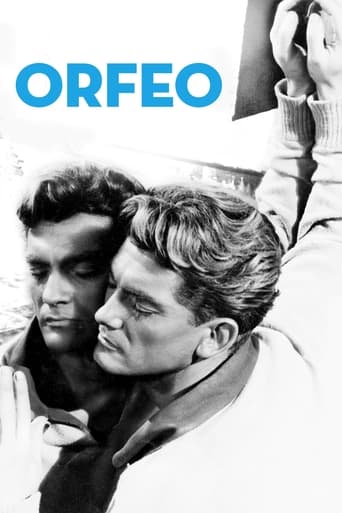
Orfeo (1950)
Orphée
Un Film de Jean Cocteau
Orfeo es un poeta obsesionado con la Muerte (la Princesa) de la cual se enamora. Un día los esbirros de la Muerte matan a Eurídice, la esposa de Orfeo, y éste decide seguirla hasta el Inframundo para rescatarla. Este film es la parte central de la trilogía órfica de Jean Cocteau: La sangre de un poeta (1932), Orfeo (1950) y El testamento de Orfeo (1960).
- Fecha de estreno
- 1950-09-29
- TMDB
- 7.7 / 10 (311)
- Duración
- 1 h 52 min
- Géneros
- Romance, Fantasía, Drama
- Director
- Jean Cocteau
- Colección
- The Orphic Trilogy
Reparto
- Jean Marais — Orphée
- François Périer — Heurtebise
- María Casares — Death
- Marie Déa — Eurydice
- Henri Crémieux — Editor
- Juliette Gréco — Aglaonice
- Roger Blin — The Poet
- Édouard Dermithe — Jacques Cégeste
- André Carnège — Judge
- René Worms — Judge
- Raymond Faure — Journalist
- Pierre Bertin — Commissioner
Curiosidades
- Rodada en: París
Orpheus is a 1950 French romantic fantasy tragedy film directed by Jean Cocteau and starring Jean Marais. It is the central part of Cocteau's Orphic Trilogy, alongside The Blood of a Poet (1930) and Testament of Orpheus (1960). Set in contemporary Paris, the film is a variation on the Greek myth of Orpheus and Eurydice, and is partially based on Cocteau's 1926 play of the same title.
Production
In his autobiography, the actor Jean-Pierre Aumont claimed that Cocteau wrote the film for him and his then-wife Maria Montez but decided to use other actors.
Filming took place from September 12 to November 16, 1949, in Paris, at Porte des Lilas for the opening scene in Café des Poètes (named specifically for the film), meant to evoke the Café de Flore of the Saint-Germain-des-Prés district and Place des Vosges when Orpheus tries to catch up with the princess who appears and disappears around the marketplace.
The film is noted for its wide array of practical and post-production effects, notably “liquid” mirrors (represented by close-ups of a vat of mercury), landscapes filmed in negative, sequences shot in reverse, a vertical shot of a plateau on the ground (when Orpheus and Heurtebise return for the second time to the Underworld), superimposition (characters appearing or disappearing, Heurtebise being able to move while seemingly standing still) and…
Marais wrote that “Cocteau had certain sets built so that the walls of the houses became the floor and the ground became the wall: thus our movement was made more difficult and was restricted by gravity. That day, I saw that the technical team was sceptical, but the next day, at the screening, they were howling with enthusiasm.”
Leer en Wikipedia · Texto de Wikipedia, CC BY-SA 4.0. Datos de Wikidata.
Recomendadas
- Mélo 1986 · ★ 6.9
- El secreto de Adaline 2015 · ★ 7.5
- Luna 2018 · ★ 6.4
- Moulin Rouge 2001 · ★ 7.5
- Asuntos privados en lugares públicos 2006 · ★ 6.4
- Un amor sin fin 2020 · ★ 6.6
- Más que nunca 2022 · ★ 6.4
- Lo que el día debe a la noche 2012 · ★ 7.6
- Cyrano 2021 · ★ 6.3
- Toda una vida en un año 2020 · ★ 8.2
- Hola, adiós y todo lo que pasó 2022 · ★ 6.1
- El fantasma de la ópera 2004 · ★ 7.3