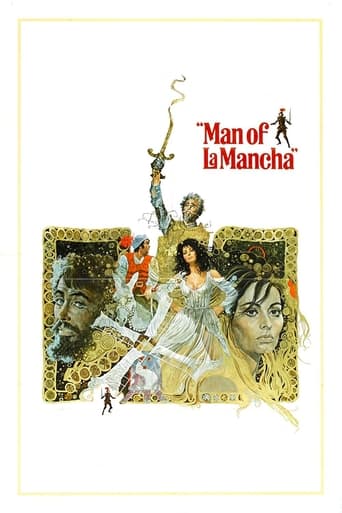
Man of La Mancha (1972)
Peter O'Toole, Sophia Loren and James Coco dream 'The Impossible Dream' in...
In the 16th century, poet, playwright and part-time actor Miguel de Cervantes has been arrested, together with his manservant, by the Spanish Inquisition. They're accused of presenting an entertainment offensive to the Inquisition. Inside the huge dungeon into which they have been cast, the other inmates gang up on Cervantes and his manservant, staging a mock trial, with the intention of stealing or burning his possessions. Cervantes wishes to desperately save a manuscript he carries with him and stages, with costumes, makeup, and the participation of the other prisoners, an unusual defense—the story of Don Quixote.
- Date of release
- 1972-12-12
- TMDB
- 6.6 / 10 (79)
- Runtime
- 2h 12m
- Genres
- Adventure, Comedy, Drama, Music
- Director
- Arthur Hiller
Casting
- Peter O'Toole — Don Quixote De La Mancha / Miguel de Cervantes / Alonso Quijana
- Sophia Loren — Dulcinea / Aldonza
- James Coco — Sancho Panza / Cervantes' Manservant
- Ian Richardson — The Padre
- Harry Andrews — The Innkeeper / The Governor
- John Castle — Sanson Carrasco / The Duke
- Brian Blessed — Pedro
- Julie Gregg — Antonia Quijana
- Rosalie Crutchley — The Housekeeper
- Gino Conforti — The Barber
- Marne Maitland — Captain of the Guard
- Dorothy Sinclair — The Innkeeper's Wife
Interesting facts
- Budget: $12M
- Based on: Don Quixote and Man of La Mancha
- Awards: 1 · Nominations: 1. Including: National Board of Review: Top Ten Films
Man of La Mancha is a 1972 film adaptation of the Broadway musical Man of La Mancha by Dale Wasserman, with music by Mitch Leigh and lyrics by Joe Darion. The musical was suggested by the classic novel Don Quixote by Miguel de Cervantes, but more directly based on Wasserman's 1959 non-musical television play I, Don Quixote, which combines a semi-fictional episode from the life of Cervantes with scenes from his novel.
Production
In 1967, United Artists paid more than $2.25 million for film rights to Man of La Mancha, the second-highest amount ever paid for the rights to a musical play, behind only the $5.5 million that Warner Bros. paid for the rights to My Fair Lady. In addition to the initial outlay, UA agreed to pay 25% of the gross, if the gross exceeded 2.5-times the negative cost and there were at least $0.5 million in album sales.
According to both associate producer Saul Chaplin (in his memoir The Golden Age of Movie Musicals and Me) and Dale Wasserman (in his memoir The Impossible Musical), the film had a troubled production history. Originally, Wasserman, composer Mitch Leigh (as associate producer), and Albert Marre (who had directed the original show, but had never before directed a film), were hired to make the motion picture, and original cast stars Richard Kiley an…
British director Peter Glenville was then brought in (it was he who cast Peter O'Toole as Cervantes and Quixote), but he was also fired when it was learned that he planned to eliminate most of the play's songs from the film. John Hopkins, who had been hired by Glenville also left the project when Glenville was fired.
It was then that Arthur Hiller and Saul Chaplin joined the project. Hiller was brought on to the film because he had just made The Hospital for United Artists.
Hiller re-hired Wasserman to adapt his own stage libretto, although, according to Wasserman, the film's new opening sequence, which shows the arrest of Cervantes before he enters the prison, was not conceived by him; it was most likely written by John Hopkins.
Read on Wikipedia · Text from Wikipedia, CC BY-SA 4.0. Data from Wikidata.
Recommended
- Tom Sawyer 1973 · ★ 6.5
- Godspell 1973 · ★ 6.7
- Rosencrantz & Guildenstern Are Dead 1991 · ★ 6.9
- The Court Jester 1955 · ★ 7.3
- The Cheetah Girls 2 2006 · ★ 6.3
- Muppets Most Wanted 2014 · ★ 6.3
- The Four Musketeers 1974 · ★ 6.5
- Coda 2020 · ★ 6.1
- Pinocchio 2009 · ★ 6.1
- The Man Who Killed Don Quixote 2018 · ★ 6.7
- Easy Come, Easy Go 1967 · ★ 6.0
- Cats 1998 · ★ 7.2