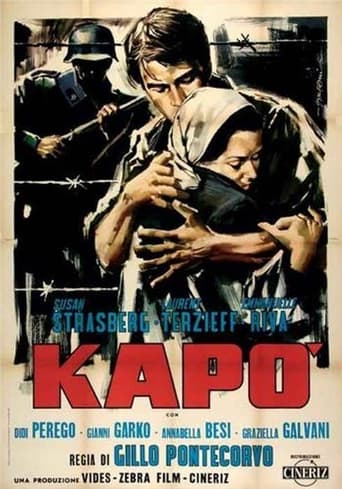
零点地带 (1960)
Kapò
Gillo Pontecorvo生于比萨。在大学时专攻化学,但大学毕业后进入报界,在报纸编电影版,不久到巴黎做意大利报纸的通讯记者,结交了不少法国影人,并且做了法国名导演尤亚克莱的副导演。回国后连续拍了几部纪录片,1955年拿他导演的《Giovanna》参加威尼斯影展获得好评。1957年他与马雷堤合导《蓝色的海》,故事描述渔人用炸药取鱼,结果自己也被炸药炸死,是充满了对穷人的同情和抗议社会的作品。1960年导演《零点地带》,描写在纳粹集中营里那些意大利走狗的丑行,题材新鲜,获得评价甚高。其后沉默了七年,才导演轰动全球的《阿尔及尔之战》,这部运用写实手法描写阿尔及尔市民反抗统治者法军的伤作品,不论是他的写实,和那徐徐升高的故事性,都达到电影艺术的最高境界。
演员阵容
- Susan Strasberg — Edith
- Laurent Terzieff — Sascha
- 埃玛妞·丽娃 — Terese
- Didi Perego — Sofia
- Gianni Garko — Karl
- Annabella Besi — Carole
- Graziella Galvani — Isabelle
- Paola Pitagora — Georgette
- Eleonora Bellinzaghi
- Bruno Scipioni
- Dragomir Felba
- Mira Dinulović
趣闻
- 拍摄地:萨格勒布和南斯拉夫
- 获奖:0 · 提名:2
Kapò is a 1960 historical war drama film directed and co-written by Gillo Pontecorvo. It was one of the first narrative films to deal explicitly with the subject of the Holocaust, with graphic depictions of Nazi concentration camps which made it controversial at the time. A co-production of Italian, French, and Yugoslavian companies, the film stars American actress Susan Strasberg, along with Laurent Terzieff, Emmanuelle Riva, Didi Perego and Gianni Garko. The title refers to a prisoner functionary in the Nazi concentration camps.
Production
Pontecorvo and his screenwriter Franco Solinas were inspired to make the film after reading Primo Levi's memoir If This Is a Man. The writing process was a tense one, as Pontecorvo and Solinas had contrasting ideas on what the film should be - Pontecorvo believed Solinas' script was too melodramatic and nearly broke off their partnership before the intervention of producer Franco Cristaldi.
Claudia Cardinale was considered for the lead role before Susan Strasberg, who was known for playing Anne Frank in the Broadway play The Diary of Anne Frank, was cast. This later caused problem on set, because the American actress did not speak Italian, and Pontecorvo had to communicate with her through an interpreter.
Filming took place at Jadran Studios in Zagreb. The culture clash between the Italian and Yugoslavian crews also caused problems. Pontecorvo was forced to work with a Yugoslavian cinematographer, Aleksandar Sekulović, whose smooth, "Hollywood-style" photography he found inappropriate for the subject matter, much preferring the vérité-style photography by the Italian second unit cameramen.
在维基百科阅读更多 · 文本来自维基百科,CC BY-SA 4.0。数据来自 Wikidata。