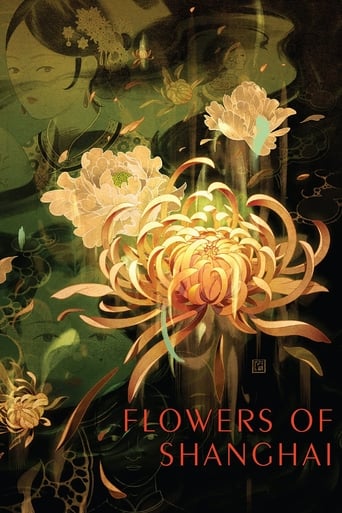
Flowers of Shanghai (1998)
海上花
At the end of the 19th century, Shanghai is divided into several foreign concessions. In the British concession, a number of luxurious “flower houses” are reserved for the male elite of the city. Since Chinese dignitaries are not allowed to frequent brothels, these establishments are the only ones that these men can visit. They form a self-contained world, with its own rites, traditions and even its own language. The men don’t only visit the houses to frequent the courtesans but also to dine, smoke opium, play mahjong and relax. The women working there are known as the “flowers of Shanghai”.
- Date of release
- 1998-10-01
- TMDB
- 6.9 / 10 (119)
- Runtime
- 1h 53m
- Genres
- Drama
- Director
- Hou Hsiao-hsien
Casting
- Tony Leung Chiu-wai — Wang
- Michiko Hada — Crimson
- Carina Lau — Pearl
- Michele Reis — Emerald
- Jack Kao — Luo
- Rebecca Pan — Huang
- Stephanie Fong Shuan — Jade
- Annie Shizuka Inoh — Golden Flower
- Vicky Wei — Jasmin
- Firebird Liu — Vagabond #2
- Hsu Hui-Ni — Shu-Fang's sister
- Shuan Fang — Jade
Interesting facts
- Awards: 0 · Nominations: 1
Flowers of Shanghai is a 1998 drama film directed by Hou Hsiao-hsien. It is based on the novel The Sing-song Girls of Shanghai (1892) by Han Bangqing, which was originally written in the Wu language (吳語) and translated into Mandarin Chinese by Eileen Chang.
Production
According to the screenwriter Chu Tʽien-wen, Flowers of Shanghai was originated with Hou Hsiao-Hsien's intention to create a collection of art production resources for Taiwan cinema with the assistance of art director Hwarng Wern-ying (黃文英), as he did for sound recording with Tu Duu-Chi (杜篤之) .
Hou Hsiao-Hsien originally intended to shoot Flowers of Shanghai in China, but the application was not approved by the Chinese government. The production was forced to be completed in Taiwan, which is why the film has no outdoor scenes. Without proper locations that could be the background for the period, the film was all shot in the studio.
Hou Hsiao-hsien's long shots are used to their fullest potential in this film. The nearly two-hour film consists of fewer than forty shots. The long takes are edited by using fade-ins and fade-outs imitating the rhythm of breathing, which also allow the viewers to have enough time to fully appreciate the recreation of old Shanghai on screen.
Ah Cheng (Zhong Acheng, 鍾阿城) was responsible for sourcing and ordering most of the costumes and props for the film from China. He proposed to Hou that the film should not use electric bulbs but be lit with candles to give the room a warm and nostalgic atmosphere.
Read on Wikipedia · Text from Wikipedia, CC BY-SA 4.0. Data from Wikidata.
Recommended
- One Second 2020 · ★ 7.3
- What Time Is It There? 2001 · ★ 7.0
- Black Dog 2024 · ★ 7.1
- Raise the Red Lantern 1991 · ★ 8.0
- Caught by the Tides 2024 · ★ 6.7
- Bobby Jones: Stroke of Genius 2004 · ★ 5.9
- Farewell My Concubine 1993 · ★ 8.0
- Buddha Mountain 2011 · ★ 6.7
- Tigertail 2020 · ★ 6.7
- Taipei Story 1985 · ★ 7.5
- Hammett 1982 · ★ 6.2
- Upstream 2024 · ★ 6.8