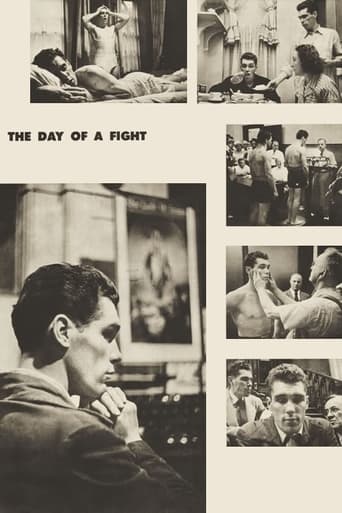
Day of the Fight (1951)
Stanley Kubrick’s debut documentary, following Irish-American middleweight boxer Walter Cartier on April 17, 1950—the day of his bout with Bobby James. The film traces Cartier’s quiet morning rituals, training, and anxious hours before the match, culminating in his swift victory that night in Newark. Opening with a brief history of boxing, Kubrick’s tightly crafted short captures the discipline, isolation, and tension behind a fighter’s daily routine.
- Date of release
- 1951-04-26
- TMDB
- 5.7 / 10 (181)
- Runtime
- 13m
- Genres
- Documentary
- Director
- Stanley Kubrick
Casting
- Vincent Cartier — Self, Walter's twin brother and manager
- Walter Cartier — Self
- Nat Fleischer — Self, boxing historian
- Bobby James — Self, Walter's opponent
- Judy Singer — Self, female fan in crowd (uncredited)
- Stanley Kubrick — Self (man at ringside with camera) (uncredited)
- Alexander Singer — Self
- Douglas Edwards — Narrator
Interesting facts
- Filmed in: New York City and New Jersey
Day of the Fight is a 1951 American short-subject documentary film financed and directed by Stanley Kubrick, who based this black-and-white motion picture on a photo feature he shot two years earlier for Look magazine.
Production
Kubrick and Singer used daylight-loading Eyemo cameras that take 100-foot spools of 35mm black-and-white film to shoot the fight, with Kubrick shooting hand-held (often from below) and Singer's camera on a tripod. The 100-foot reels required constant reloading, and Kubrick did not catch the knock-out punch which ended the bout because he was reloading. Singer did, however.
Day of the Fight is the first film credit on composer Gerald Fried's resume. Kubrick did not pay him for his work in scoring the production. "He thought the very fact that my doing the music" for the film "got me into the profession was enough payment", Fried told The Guardian in 2018, although he conceded in the same newspaper interview that Kubrick's point was accurate.
Since the original planned buyer of the documentary went out of business, Kubrick was able to sell Day of the Fight to RKO Pictures for $4,000, resulting in only a net profit of $100 for him after paying the film's $3,900 in production costs.
Day of the Fight was released as part of RKO-Pathé's "This Is America" series and premiered on 25 April 1951 at New York's Paramount Theater, on the same program as the film My Forbidden Past. Frank Sinatra headlined the live stage show that day
Read on Wikipedia · Text from Wikipedia, CC BY-SA 4.0. Data from Wikidata.
Recommended
- Champs 2015 · ★ 6.4
- Being James Bond 2021 · ★ 7.8
- Quay 2015 · ★ 6.0
- Conor McGregor: Notorious 2017 · ★ 6.9
- Amazing Grace 2018 · ★ 7.1
- The Class of ‘92 2013 · ★ 7.1
- Come See Me in the Good Light 2025 · ★ 7.0
- Naqoyqatsi 2002 · ★ 6.2
- Aquaman: Heroines of Atlantis 2019 · ★ 6.2
- Embrace the Panda: Making Turning Red 2022 · ★ 6.8
- Ram Dass, Going Home 2017 · ★ 5.9
- Anna Nicole Smith: You Don't Know Me 2023 · ★ 6.1