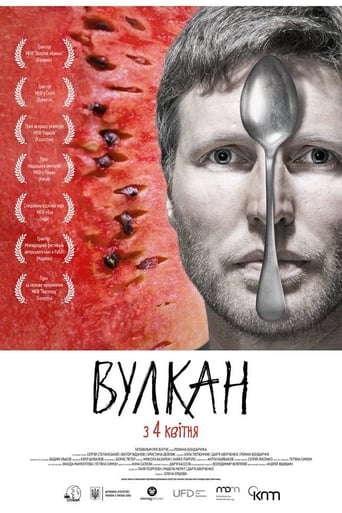
Vulkan (2018)
Вулкан
Nach einer Reihe seltsamer Zufälle strandet der Übersetzer Lukas während einer OSZE-Mission auf einmal in der Nähe eines abgelegenen Ortes in der südukrainischen Steppe. Keine Ahnung, wohin er gehen soll, findet der Städter schließlich Zuflucht bei einem schrägen Einheimischen namens Vova. Fasziniert von Vova und dessen Tochter Marushka schmilzt Lukas' Abneigung gegen das Leben in der Provinz langsam dahin.
- Erscheinungsdatum
- 2018-07-01
- TMDB
- 6.4 / 10 (26)
- Laufzeit
- 1 Std. 44 Min.
- Genres
- Komödie, Drama
- Regie
- Роман Бондарчук
Besetzung
- Сергій Степанський — Lukas
- Віктор Жданов — Vova
- Христина Дейлик — Marushka
- Tamara Socenko — Mother
- Oleksandr Ljakin — Balitskyi
Wissenswertes
- Auszeichnungen: 1 · Nominierungen: 0. Darunter: 100 best films in the history of Ukrainian cinema
Volcano is a 2018 Ukrainian-German-Monaco drama film, and the feature directorial debut of Roman Bondarchuk. Through the character Lukas, an interpreter who is stranded in the region he was to help monitor for a security organization, the film examines the lives of people on the southern Ukrainian steppe who live in anarchic freedom, seemingly forgotten by the outside world.
Production
The script began development in the early 2010s, initially following a foreigner who was stranded at the Odesa airport due to volcanic eruptions in Iceland, and who then began traveling into the Ukrainian countryside. Writers Daria Averchenko, Roman Bondarchuk and Alla Tyutyunnyk greatly updated the plot following the Euromaidan movement, the 2014 Ukrainian revolution, the Russian annexation of Crimea and the War in Donbass, but kept the title "V…
Bondarchuk and Averchenko have backgrounds in documentary-making, and had originally envisioned the project as a documentary. The character Vova is based on Averchenko's uncle. The writers based several other characters on family members in Kherson. The film carries a dedication in memory of those whose villages were flooded by the creation of the Kakhovka Reservoir.
In 2014, the production secured half of its 10,000,000 Ukrainian hryvnia budget from the Ukrainian State Film Agency. It was produced by Olena Yershova of Tato Film (Ukraine) with co-producers Averchenko of South (Ukraine), Tanja Georgieva-Waldhauer of Elemag Pictures (Germany) and Michel Merkt of KNM (Monaco).
The film was shot in Beryslav, Kherson Oblast, Ukraine, on the Dnieper river, one hour north of Crimea. The main camera was a Red Epic with Ultra Prime lenses; night exteriors were filmed with a Sony Alpha 7. All shooting was from tripod or shoulder mounts. The script was significantly reworked during filming.
Post-production was completed at Arri Media in Germany. According to Bondarchuk, the most complicated shots were the underwater scenes. Bondarchuk also directed a music video for "DakhaBrakha", a song which is used for the closing credits of the film.
Auf Wikipedia weiterlesen · Text aus Wikipedia, CC BY-SA 4.0. Daten aus Wikidata.
Empfohlen
- Landline 2017 · ★ 6.2
- SubUrbia 1997 · ★ 6.2
- Somewhere in Queens 2023 · ★ 6.3
- Tyler Perry's Madea on the Run - The Play 2017 · ★ 7.5
- On Becoming a Guinea Fowl 2024 · ★ 7.5
- Es bleibt in der Familie 2003 · ★ 6.0
- Thunderstruck 2012 · ★ 6.2
- My Own Love Song 2010 · ★ 6.2
- Class 1983 · ★ 6.0
- Chloe rettet die Welt 2015 · ★ 5.9
- CQ 2001 · ★ 5.9
- Bühne des Lebens 2016 · ★ 6.4