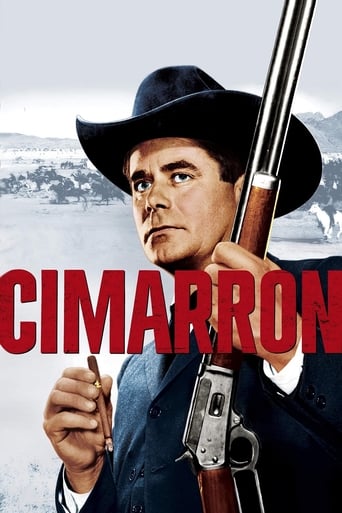
Cimarron (1960)
The story of a man, a land and a love!
The epic story of a family involved in the Oklahoma Land Rush of April 22, 1889.
- Date of release
- 1960-12-01
- TMDB
- 6.3 / 10 (84)
- Runtime
- 2h 27m
- Genres
- Western
- Director
- Anthony Mann
Casting
- Glenn Ford — Yancey 'Cimarron' Cravat
- Maria Schell — Sabra Cravat
- Anne Baxter — Dixie Lee
- Arthur O'Connell — Tom Wyatt
- Russ Tamblyn — William Hardy, The Cherokee Kid
- Mercedes McCambridge — Mrs. Sarah Wyatt
- Vic Morrow — Wes Jennings
- Robert Keith — Sam Pegler
- Charles McGraw — Bob Yountis
- Harry Morgan — Jessie Rickey
- David Opatoshu — Sol Levy
- Aline MacMahon — Mrs. Mavis Pegler
Interesting facts
- Based on: Cimarron
- Awards: 0 · Nominations: 2
Cimarron is a 1960 American epic Western film based on the 1930 Edna Ferber novel Cimarron. The film stars Glenn Ford and Maria Schell and was directed by Anthony Mann and Charles Walters, though Walters is not credited onscreen. Ferber's novel was previously adapted as a film in 1931; that version won three Academy Awards.
Production
In February 1941, MGM bought the remake rights to Cimarron from RKO for $100,000. In 1947, MGM announced an operetta version starring Kathryn Grayson and produced by Arthur Freed, but this did not happen. In February 1958, MGM announced its plans to produce Cimarron as the studio's second film using the MGM Camera 65 process following Raintree Country (1957). One month later, Elizabeth Taylor and Rock Hudson were considered to star in the film.
Anthony Mann was eventually named as director. He had pitched to his vision to MGM executives, explaining: "I wanted to show a huge plain out in the West with nothing on it, and how a group of men and women gathered at a line, and tore out across this plain and set up their stakes as claim for the land.
As production continued, the on-location shoot experienced dust storms, in which producer Edmund Grainger decided to relocate the production on the studio backlot despite Mann's insistence to film entirely on location. Mann explained: "We had a couple of storms—which I shot in anyway—but they thought we'd have floods and so on, so they dragged us in and everything had to be duplicated on the set.
Also, during filming, Anne Baxter, who played Dixie Lee, revealed in her autobiography Intermission that Ford and Maria Schell developed an offscreen romance: "During shooting, they'd scrambled together like eggs. I understood she'd even begun divorce proceedings in Germany. It was obviously premature of her." However, by the end of filming, "... he scarcely glanced or spoke in her direction, and she looked as if she were in shock."
Arnold Schulman later called Mann "a nice, sweet man, but I got the feeling he was sort of burned out. The whole film was a disaster. The studio was a mess. The head of the studio was in danger of being fired. There was a lot of tension; the picture was costing too much; and we couldn't get the script right. It was a badly written script. I take my share of the credit.
Read on Wikipedia · Text from Wikipedia, CC BY-SA 4.0. Data from Wikidata.
Recommended
- Love's Enduring Promise 2004 · ★ 6.8
- Dances with Wolves 1990 · ★ 7.8
- Oklahoma! 1955 · ★ 6.6
- Love's Long Journey 2005 · ★ 7.0
- Far and Away 1992 · ★ 6.8
- In Old Oklahoma 1943 · ★ 6.2
- 3:10 to Yuma 1957 · ★ 7.3
- The Way West 1967 · ★ 6.1
- Hombre 1967 · ★ 7.0
- Call of the Wild 1935 · ★ 6.3
- Love's Unfolding Dream 2007 · ★ 7.0
- The Call of the Wild 1972 · ★ 6.1