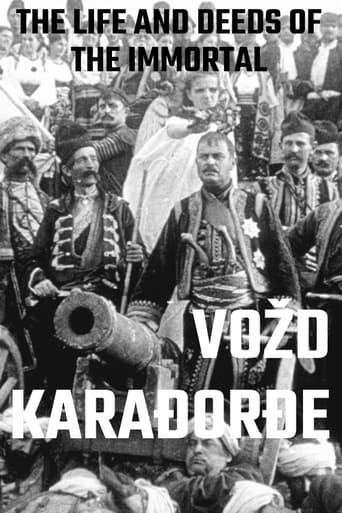
The Life and Deeds of the Immortal Vožd Karađorđe (1911)
Живот и дела бесмртног вожда Карађорђа
A biography of Karađorđe, the famed leader of the rebellion against the Ottoman Empire in 1804, tracing his whole life from childhood until his death in 1817.
- Date of release
- 1911-10-23
- TMDB
- 5.6 / 10 (12)
- Runtime
- 1h 28m
- Genres
- Drama, History, War
- Director
- Ilija Stanojević 'Čiča'
Casting
- Milorad Petrović — Karađorđe
- Teodora Arsenović — Jelena, Karađorđe's wife
- Vukosava Jurković — Karađorđe's mother
- Ilija Stanojević 'Čiča' — Vujica Vulićević / Turkish Pasha
- Dragoljub Sotirović — Hajduk Veljko
- Dobrica Milutinović — Janko Katić
- Sava Todorović — Old man Fočo
- Persa Pavlović — National woman
- Jovan Antonijević
- Vitomir Bogić
- Mileva Bošnjaković
- Dimitrije Ginić
Interesting facts
The Life and Deeds of the Immortal Leader Karađorđe, or simply Karađorđe, is a 1911 Serbian silent film directed by Ilija Stanojević and starring Milorad Petrović. It was the first feature film released in Serbia and the Balkans. Petrović portrays the eponymous rebel leader Karađorđe, who led the First Serbian Uprising of 1804–1813.
Production
Serbia's first movie theatre, the Paris Cinema, located inside the eponymous Hotel Paris, at Belgrade's Terazije Square, was opened by the hotelier Svetozar Botorić in December 1908. Up until that point, films could only be viewed in traveling theatres which periodically visited Serbia's large cities. Very few members of the country's intelligentsia considered cinema to have any cultural value and fewer still deemed it financially rewarding.
Botorić was inspired to produce feature films after seeing Charles Le Bargy and André Calmettes's The Assassination of the Duke of Guise (French: L'Assassinat du Duc de Guise), an early example of narrative cinema. Up until that point, all films made in Serbia were documentary and ethnological films, covering events of historical significance such as official functions and state ceremonies to events of a more banal nature, such as common people o…
Karađorđe was based on a number of sources, namely an eponymous stage play by the playwright Miloš Cvetić, various biographies and hagiographies about the rebel leader, as well as the epic poem The Start of the Revolt Against the Dahijas (Serbian: Početak bune protiv dahija), which is traditionally attributed to the bard Filip Višnjić.
In order to lend the project greater credibility, Botorić enlisted actors from the National Theatre for the film. Milorad Petrović, a veteran stage actor, was given the role of Karađorđe. The child actor who played the adolescent Karađorđe was coincidentally also named Milorad Petrović. Jevrem Božović played five different characters, including Karađorđe's father and Karađorđe's rival Miloš Obrenović.
Karađorđe was directed by Stanojević. The film had a total budget of 20,000 dinars. Botorić had attempted to persuade the Royal Serbian Government to finance the film, but without success. Karađorđe was filmed in Belgrade and its environs. Principal photography lasted from mid-July to mid-August 1911. De Beéry, whom Botorić had employed to film newsreels in the past, was the film's cinematographer.
Read on Wikipedia · Text from Wikipedia, CC BY-SA 4.0. Data from Wikidata.
Recommended
- The Last Rifleman 2023 · ★ 6.6
- The Scarlet and the Black 1983 · ★ 7.1
- Outlaws - For Greater Glory 2012 · ★ 7.0
- Prizefighter: The Life of Jem Belcher 2022 · ★ 6.2
- Ararat 2002 · ★ 6.1
- Field of Lost Shoes 2015 · ★ 6.1
- Waiting for Anya 2020 · ★ 6.3
- Beneath Hill 60 2010 · ★ 6.8
- The One That Got Away 1957 · ★ 6.8
- Walking with the Enemy 2014 · ★ 6.3
- The Kill Team 2019 · ★ 6.5
- Gods and Generals 2003 · ★ 6.4