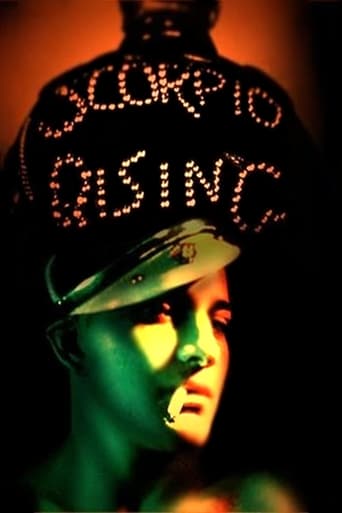
Scorpio Rising (1964)
A gang of bikers prepares for a race as sexual, sadistic, and occult images are cut together.
- Data lansării
- 1964-06-01
- TMDB
- 6.6 / 10 (158)
- Durată
- 28 min
- Genuri
- Muzică
- Regizor
- Kenneth Anger
- Colecție
- The Magick Lantern Cycle
Distribuție
- Ernie Allo — Joker (uncredited)
- Bruce Byron — Scorpio (uncredited)
- Frank Carifi — Leo (uncredited)
- Steve Crandell — Blondie (uncredited)
- Johnny Dodds — Kid (uncredited)
- Bill Dorfman — Back (uncredited)
- Nelson Leigh — Jesus Christ (archive footage) (uncredited)
- John Palone — Pinstripe (uncredited)
- Barry Rubin — Fall Guy (uncredited)
- Johnny Sapienza — Taurus (uncredited)
Curiozități
Scorpio Rising is a 1963 American experimental short film shot, edited, co-written and directed by Kenneth Anger, and starring Bruce Byron as Scorpio. Loosely structured around a prominent soundtrack of 1960s pop music, it follows a group of bikers preparing for a night out.
Production
After living in Europe for several years, Anger returned to the United States, staying in Brooklyn, New York with Marie Menken and Willard Maas. He encountered a group of bikers who met at Coney Island every weekend. He got to know them by photographing their bikes.
Anger's first choice for the lead actor was Jim Powers; however, Powers died in a car crash. Anger was in Times Square when he first met Richard MacAulay, who went by the name Bruce Byron as an homage to James Byron Dean. Byron also used his astrological sign Scorpio as a nickname, which became the name of the main character.
Anger spent seven days shooting Byron's scenes. While Byron's wife Rosemary was out of town, they filmed scenes at his apartment in Greenwich Village. He carried around an amulet with a scorpion for good luck. Byron was an ex-Marine. Byron's home was decorated with picture of his idols, James Dean and Marlon Brando. By chance, Brando's appearance in The Wild One was broadcast while they were filming, so Anger shot it off of the television.
Byron and his wife attended a Halloween party in Brooklyn. Anger bought them four barrels of beer. Anger only filmed the men who attended because they didn't want their girlfriends to be filmed. They initiated a new member by spreading mustard on his genitals. Later that night, they went to an empty, deconsecrated church.
Anger spent three months in New York filming the bikers. He shot on Ektachrome reversal film. Anger's design makes extensive use of non-diegetic lighting, rendering his subjects in non-natural hues for artistic effect.
Citește pe Wikipedia · Text din Wikipedia, CC BY-SA 4.0. Date din Wikidata.
Recomandate
- The Lonely Island: Anecdote de pe teren 2019 · ★ 6.3
- Suburbia 1984 · ★ 6.7
- The Bugs Bunny/Road Runner Filmul 1979 · ★ 7.4
- Urât ca un coiot 2000 · ★ 6.3
- Make Your Move 2013 · ★ 5.8
- Heavy Metal 1981 · ★ 6.5
- Smithereens 1982 · ★ 6.4
- Tupac: Resurrection 2003 · ★ 7.9
- I Am Easy to Find 2019 · ★ 7.2
- Ultimul atelier de reparații 2024 · ★ 7.5
- Anima 2019 · ★ 7.3
- Ghosts 1997 · ★ 8.1