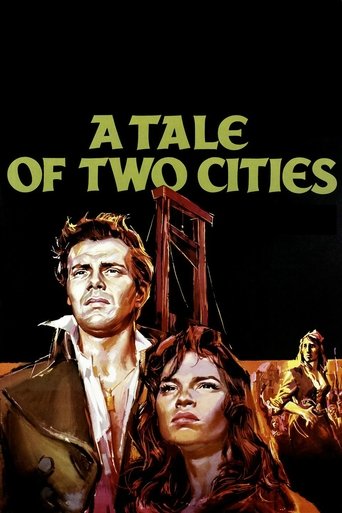
Historia de dos ciudades (1958)
A Tale of Two Cities
Revolución Francesa (1789-1799). Adaptación de la novela histórica del mismo título del escritor inglés Charles Dickens (1812-1870). El abogado inglés Sydney Carton, que lleva una vida insustancial e infeliz, se queda prendado de los encantos de la joven Lucie Manette, pero ella se casa con Charles Darnay. Cuando, en plena revolución, Darnay va a París para liberar a un criado suyo injustamente encarcelado, también él es conducido a prisión y condenado a morir en la guillotina. Entonces Carton, a pesar de su amor por Lucie, elabora un atrevido plan para salvar a su rival.
- Fecha de estreno
- 1958-02-07
- TMDB
- 6.8 / 10 (22)
- Duración
- 1 h 55 min
- Géneros
- Drama, Historia, Romance
- Director
- Ralph Thomas
Reparto
- Dirk Bogarde — Sydney Carton
- Dorothy Tutin — Lucie Manette
- Paul Guers — Charles Darnay
- Marie Versini — Marie Gabelle
- Ian Bannen — Gabelle
- Cecil Parker — Jarvis Lorry
- Stephen Murray — Dr. Manette
- Athene Seyler — Miss Pross
- Alfie Bass — Jerry Cruncher
- Sacha Pitoëff — Gaspard
- Christopher Lee — Marquis St. Evremonde
- Donald Pleasence — Barsad
Curiosidades
- Basada en: Historia de dos ciudades
- Rodada en: Pinewood
A Tale of Two Cities is a 1958 British film directed by Ralph Thomas and starring Dirk Bogarde and Dorothy Tutin. It is a period drama based on parts of Charles Dickens' novel A Tale of Two Cities (1859).
Production
Thomas Clarke wrote the script. He had read the novel at school and "had been disappointed by a book that a lesser author might have written; but I could appreciate its potential as a period action film and readily undertook to script." Clarke said he had no wish to see the 1935 version until he wrote the script as "there is always the danger in a remake that one might steal another screenwriter’s innovation under the impression that it was part…
Ralph Thomas insisted on the film being shot in black and white as he felt the book "was written in black and white, and it's got to be made in black and white." He was influenced by a French film Casque d'Or set in a similar period which was in black and white. Box says that were influenced by Gervaise as well.
Borgarde said “We all felt right from the beginning that the only way to make this film was as a documentary.” Thomas added, "For that reason, we decided against making it in colour because this would destroy the stark realism we are trying to get.”
Even in black and white the film was the most expensive British production of its year.
Dorothy Tutin said "I didn’t think I was right for the part: it needed to be a blonde, beautiful girl like Virginia McKenna. I knew the novel well, so I was never going to turn it down, I just never felt I was quite right visually. I think Dirk really got me the part and I think he was wrong, although I enjoyed the filming in France until I got ill, and I did enjoy working with Dirk, who was extremely nice."
Leer en Wikipedia · Texto de Wikipedia, CC BY-SA 4.0. Datos de Wikidata.
Recomendadas
- Más fuerte que el orgullo 1940 · ★ 6.9
- La reina Victoria 2009 · ★ 7.2
- El secreto del orfebre 2025 · ★ 7.4
- Sólo se vive una vez 1937 · ★ 7.1
- Lejos del mundanal ruido 1967 · ★ 6.9
- Capricho imperial 1934 · ★ 6.9
- No soy culpable 1947 · ★ 6.6
- El cielo y tú 1940 · ★ 7.2
- Los miserables 1935 · ★ 7.1
- La señora Miniver 1942 · ★ 7.1
- La abadía de Northanger 2007 · ★ 6.8
- Jane Eyre 1997 · ★ 7.0