热血造物 (1963)
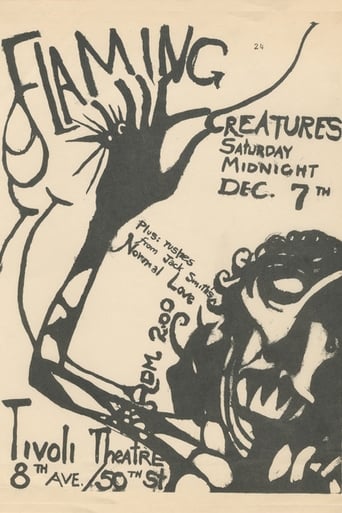
Flaming Creatures
视 觉上Flaming Creatures就是Josef von Sternberg加上疯狂的异装癖假面舞会家庭录影。Smith使用了过期黑白胶片,给影片一种缥缈的味道。影片没有情节,配乐用的是一组Maria Montez影片对白蒙太奇,hacienda音乐,和摇滚。他的影片里有搞笑阿拉伯女奴,狂放的西班牙舞者,等等。吸血鬼样的Marilyn Monroe模仿者,当然是男的,从棺材中爬出,出现在空镜头里,手里拿着一捆花,走过一堆尸体。然后开始掀开一尸体的衣服撩拨他的阴茎。就这样,性的复活最终让所有尸体复活,影片如标准的Busby Berkeley音乐剧一样结束了。
- 上映日期
- 1963-04-29
- TMDB
- 4.8 / 10 (63)
- 片长(分钟)
- 42分钟
- 类型
- 恐怖, 喜剧, 剧情
- 导演
- Jack Smith
演员阵容
- Francis Francine — Francis Francine
- Sheila Bick — Delicious Dolores
- Joel Markman — Our Lady of the Docks
- Mario Montez — The Spanish Girl
- Arnold Rockwood — Arnold
- Judith Malina — The Fascinating Woman
- Marian Zazeela — Marian Zazeela
- Beverly Grant — Whirling Dervish
- Piero Heliczer
趣闻
Flaming Creatures is a 1963 American experimental film directed by Jack Smith. The film follows an ensemble of drag performers through several disconnected vignettes, including a lipstick commercial, an orgy, and an earthquake. It was shot on a rooftop on the Lower East Side on a very low budget of only $300, with a soundtrack from Smith's roommate Tony Conrad. It premiered April 29, 1963, at the Bleecker Street Cinema in Greenwich Village.
Production
Smith shared an apartment with artist Marian Zazeela for a period during the early 1960s. He began taking seminude black-and-white photographs with her as a model, along with Francis Francine, Joel Markman, Mario Montez, Arnold Rockwood, and Irving Rosenthal. This grew into The Beautiful Book, a small volume of photographs published with the help of Piero Heliczer. The book began to develop the aesthetic of Flaming Creatures.
Smith conceived the idea of making a film to serve as a vehicle for Zazeela. However, she began working with composer La Monte Young and was unable to participate in Smith's project. After she moved out, he became roommates with Tony Conrad and replaced Zazeela with Sheila Bick.
Filming of Flaming Creatures took place over eight weekend afternoons in mid to late 1962. Many of the models from The Beautiful Book made appearances in the film. Smith held shoots on the roof of the Windsor Theatre, at 412 Grand Street on the Lower East Side. Dick Preston offered his loft above the theatre for use as a prop department and dressing room.
Smith filmed on a Bolex 16 mm camera borrowed from Preston. He had observed the effects of using out-of-date film while working on Ken Jacobs' Star Spangled to Death and decided to use the technique after seeing Ron Rice's The Flower Thief. He mixed multiple black-and-white reversal film stocks, mostly specialty or Army surplus stock stolen from the discard bins at a Camera Barn store.
The film's working title was Pasty Thighs and Moldy Midriffs; Smith also considered using Flaking Moldy Almond Petals, Moldy Rapture, or Horora Femina. He was highly influenced by director Josef von Sternberg and actress Maria Montez, both of whom he discussed in essays published in Film Culture before the film's release.
在维基百科阅读更多 · 文本来自维基百科,CC BY-SA 4.0。数据来自 Wikidata。