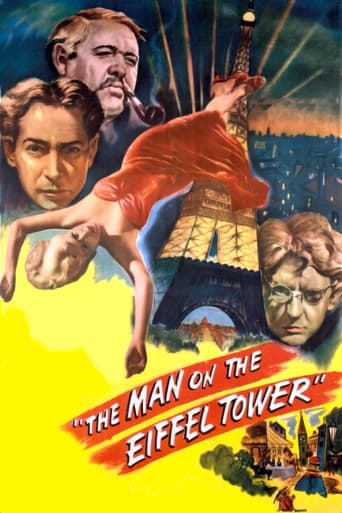
The Man on the Eiffel Tower (1949)
PARIS... GAY, ALLURING... MASKING A STRANGE ADVENTURE!
A down-and-out student is hired to kill a wealthy woman. When someone else is suspected of the crime, the student taunts police until they realize that they may have to wrong man.
- Date of release
- 1949-12-12
- TMDB
- 5.2 / 10 (24)
- Runtime
- 1h 37m
- Genres
- Thriller
- Director
- Burgess Meredith
Casting
- Charles Laughton — Inspector Jules Maigret
- Franchot Tone — Johann Radek
- Burgess Meredith — Joseph Heurtin
- Robert Hutton — Bill Kirby
- Jean Wallace — Edna Wallace
- Patricia Roc — Helen Kirby
- Belita — Gisella Heurtin
- George Thorpe — Comelieu
- William Phipps — Janvier
- William Cottrell — Moers
- Chaz Chase — Waiter
- Wilfrid Hyde-White — Professor Grollet
Interesting facts
- Based on: A Battle of Nerves
- Filmed in: Paris
The Man on the Eiffel Tower is a 1949 American-French mystery film, based on the 1931 novelette A Man's Head by Belgian writer Georges Simenon, featuring his detective Jules Maigret. It stars Charles Laughton in the lead role, along with Burgess Meredith, Franchot Tone, Robert Hutton, Jean Wallace, and Patricia Roc. The film was primarily directed by Meredith, his feature directorial debut, though Laughton directed several scenes himself. It was shot entirely on-location in Paris, featuring locales like the Eiffel Tower, the Seine, Pigalle.
Production
The Man on the Eiffel Tower was the first English-language film featuring the Jules Maigret character. Director Julien Duvivier had already adapted Simenon's novel for film in France in 1933.
The film was initially conceived as an American-French co-production by producer André Sarrut. Peter Lorre was cast in the title role, alongside Franchot Tone and Francophone stars Claude Dauphin and Victor Francen. French financiers pulled out before shooting began, and Charles Laughton was cast as Maigret.
Irving Allen was the original director. However, only a few days of filming, Laughton was dissatisfied with Allen's direction and threatened to quit the film if he wasn't replaced. Laughton's friend Burgess Meredith, who was already cast as Heurtin, took over as director. Though Meredith was an experienced theatre director, he had never helmed a feature film before.
Filming took place entirely in Paris between September and December 1948. The production made extensive use of locations like the Eiffel Tower, the Seine, and Pigalle. Both the poster and opening credits give star billing to the "City of Paris." Interiors were shot at Billancourt Studios and Joinville Studios. The film was shot on Ansco Color stock.
The original ending involved Radek committing suicide off the Eiffel Tower. However, French officials refused to allow the scene to be shot as scripted, afraid it might encourage actual jumps off the Tower.
Read on Wikipedia · Text from Wikipedia, CC BY-SA 4.0. Data from Wikidata.
Recommended
- The Day of the Jackal 1973 · ★ 7.5
- The Bourne Identity 2002 · ★ 7.5
- Perfect Sisters 2014 · ★ 5.8
- Evil Under the Sun 1982 · ★ 6.9
- The Pelican Brief 1993 · ★ 6.6
- Footsteps in the Fog 1955 · ★ 7.0
- Appointment with Death 1988 · ★ 6.1
- Overdrive 2017 · ★ 6.1
- Killer's Kiss 1955 · ★ 6.3
- The File on Thelma Jordon 1949 · ★ 6.5
- Black Widow 1987 · ★ 6.2
- Poker Night 2014 · ★ 5.9