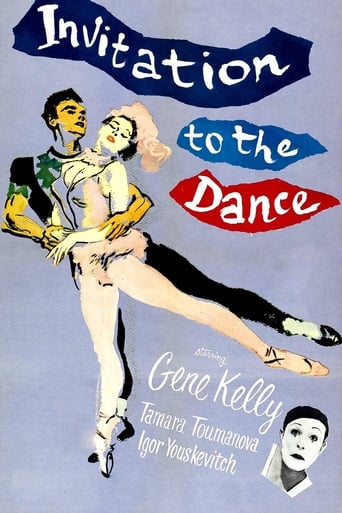
Invitation to the Dance (1956)
Three completely different stories are told through dance.
- Data de estreia
- 1956-05-22
- TMDB
- 6.0 / 10 (28)
- Duração
- 1 h 33 min
- Géneros
- Música, Fantasia
- Realizador
- Gene Kelly
Elenco
- Gene Kelly — Host / Pierrot / The Marine / Sinbad
- Igor Youskevitch — The Lover / The Artist
- Claire Sombert — The Loved
- Tamara Toumanova — The Streetwalker
- Diana Adams — Hat Check Girl
- Tommy Rall — Flashy Boyfriend
- Belita — The Femme Fatale
- David Paltenghi — The Husband
- Daphne Dale — The Wife
- Claude Bessy — The Model
- Irving Davies — The Crooner in 'Ring Around the Rosy'
- Carol Haney — Scheherazade
Curiosidades
- Prémios: 1 · Nomeações: 0. Incluindo: Urso de Ouro
Invitation to the Dance is a 1956 American dance anthology film consisting of three distinct stories, all starring and directed by Gene Kelly. It was the first film Kelly directed on his own, after co-directing three films with Stanley Donen.
Production
Kelly had gone to England for tax reasons, and Invitation to the Dance was one of three films that he made there. From the beginning, he intended it to be an all-dance film with no dialogue. This concept caused apprehension at MGM, because "dance, particularly ballet, was then considered longhair at best, homosexual at worst." Kelly initially had not wanted to appear in any of the segments because he "wanted to show the world that other people da…
The movie began filming on August 19, 1952 at MGM studios in London and continued there until December 19, with shooting also taking place at MGM in California in October 1952. Shooting continued into 1953 on the "Sinbad" sequence, which made it MGM's second longest shooting schedule at the time. MGM announced in March 1954 that the sequence would be completed by June 15, 19 months after filming began.
Difficulties arose during production of the "Ring Around the Rosy" segment. The original score, by British composer John Addison, was not judged suitable, and "the ballet was finished to bits of the Addison score and counts," with Andre Previn brought in to "tack the music onto the existing choreography."
The film originally was designed to have four segments, ending with "Sinbad." A 28-minute third segment titled "Dance Me a Song" was filmed. It consisted of popular songs interpreted through dance. The songs would have included "They Go Wild, Simply Wild About Me," "The Wiffenpoof Song," "Sunny Side of the Street," Wedding Bells Are Breaking Up That Old Gang of Mine," and "Sophisticated Lady." This sequence was filmed, but later cut.
The film was planned to be released in 1954, but it was not viewed favorably by MGM and was not released until May 1956. New York Times critic Clive Barnes later observed that "when it was let out, gave it fanfares that would be appropriate to the birth of a mouse, not even a cartoon mouse at that," and was "distributed desultorily." It was exhibited in Great Britain as a 62-minute feature composed of the first two segments.
Ler na Wikipédia · Texto da Wikipédia, CC BY-SA 4.0. Dados do Wikidata.
Recomendados
- Desafio do Ano 2013 · ★ 6.8
- Ao Ritmo do Hip Hop 2001 · ★ 6.6
- Honey 3: Desafio para Dançar 2016 · ★ 6.7
- Brigadoon: A Lenda dos Beijos Perdidos 1954 · ★ 6.5
- A Bela e o Monstro: 30º Aniversário 2022 · ★ 6.8
- Honey: Levante-se e Dance 2018 · ★ 6.9
- Música, Maestro! 1946 · ★ 5.8
- Altamente Imperfeitos 2019 · ★ 6.6
- For the Boys 1991 · ★ 6.4
- Lendas de Oz: O Regresso de Dorothy 2014 · ★ 6.2
- Dança Feroz 1998 · ★ 6.9
- Footloose - A Música Está do Teu Lado 2011 · ★ 6.6