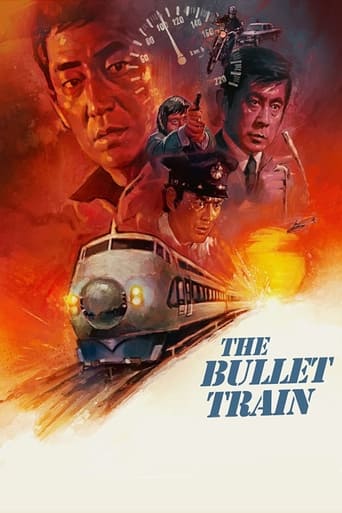
The Bullet Train (1975)
新幹線大爆破
They said it couldn't happen... But for 1500 passengers Bullet Train 109 became a nightmare journey that just couldn't be stopped!
A Japanese bullet train is threatened with a bomb that will explode automatically if the train slows below 80 km/h, unless a ransom is paid. Police race to find the bombers so the train crew can learn how to defuse the bomb.
- Date of release
- 1975-07-05
- TMDB
- 6.9 / 10 (73)
- Runtime
- 2h 32m
- Genres
- Action, Crime, Drama, Thriller
- Director
- Junya Satō
- Collection
- Bullet Train Collection
Casting
- Ken Takakura — Tetsuo Okita
- Sonny Chiba — Aoki
- Kei Yamamoto — Masaru Koga
- Eiji Gō — Shinji Fujio
- Akira Oda — Hiroshi Ôshiro
- Raita Ryu — Kikuchi
- Masayo Utsunomiya — Yasuko
- Ken Utsui — Kuramochi
- Yumiko Fujita — Akiyama
- Yumi Takigawa — SAS Staff
- Etsuko Shihomi — Telephone Operator
- Fumio Watanabe — Miyashita
Interesting facts
- Budget: ¥530M
The Bullet Train is a 1975 Japanese action thriller film directed by Junya Sato and starring Ken Takakura, Sonny Chiba, and Ken Utsui. When a Shinkansen is threatened with a bomb that will explode automatically if it slows below 80 km/h unless a ransom is paid, police race to find the bombers and to learn how to defuse the bomb.
Production
Toei Company president Shigeru Okasa asked director Junya Sato to come up with ideas for films similar to American suspense films of the time, such as The Towering Inferno and Earthquake, as he believed they would prove popular in Japan too. Sato and producer Sunao Sakagami decided to use the premise of what would happen if a bullet train could not stop.
Believing it would be too routine to have only "good" and "bad" guys, Sato used three to make the film more interesting; the Japanese National Railways (JNR), the police, and the rebels. The director said that when production asked the JNR for help, they took issue with the title "The Bullet Train's Big Explosion" and wanted it changed to something along the lines of "The Bullet Train's Close Call" or "The Bullet Train Dragnet", but Toei refused.…
Because of the film's problematic title, Sakagami felt they should have a prominent cast and went to great effort to get actors to agree. Sato noted how some of them only appear in a single scene where they normally would have used unknown actors.
Filming took 40 days. Two bullet train car sets and one Tokyo Station platform set were created for the film. Because the JNR did not provide any help, Sato said the toughest parts were the shots from the train windows and the engineer's cabin. They had a cameraman ride the train and secretly film footage that they used via blue screen. They were also refused permission to film the control room containing all of the train schedules.
Read on Wikipedia · Text from Wikipedia, CC BY-SA 4.0. Data from Wikidata.
Recommended
- Bullet Train Explosion 2025 · ★ 6.5
- Case Closed: Countdown to Heaven 2001 · ★ 7.4
- Suzuki=Bakudan 2025 · ★ 7.5
- Case Closed: The Fist of Blue Sapphire 2019 · ★ 6.2
- Robbery 1967 · ★ 6.6
- Detective Conan: Dimensional Sniper 2014 · ★ 6.8
- Tokyo Revengers 2021 · ★ 7.8
- Detective Conan: The Raven Chaser 2009 · ★ 7.3
- K-20: The Fiend with Twenty Faces 2008 · ★ 6.1
- Aurora Teagarden Mysteries: Reunited and It Feels So Deadly 2020 · ★ 7.3
- The Fast and the Fierce 2017 · ★ 5.9
- Extortion 2017 · ★ 6.1