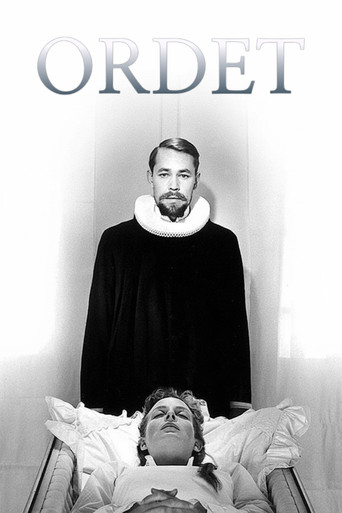
Ordet (1955)
A Legend for Today
The three sons of devout Danish farmer Morten have widely disparate religious beliefs. Youngest son Anders shares his father's religion, but eldest son Mikkel has lost his faith, while middle child Johannes has become delusional and proclaims that he is Jesus Christ himself. When Mikkel's wife, Inger goes into a difficult childbirth, everyone's beliefs are put to the test.
- Date of release
- 1955-01-09
- TMDB
- 7.9 / 10 (435)
- Runtime
- 2h 5m
- Genres
- Drama
- Director
- Carl Theodor Dreyer
Casting
- Henrik Malberg — Morten Borgen (uncredited)
- Birgitte Federspiel — Inger Borgen (uncredited)
- Emil Hass Christensen — Mikkel Borgen (uncredited)
- Preben Lerdorff Rye — Johannes Borgen (uncredited)
- Cay Kristiansen — Anders Borgen (uncredited)
- Ejner Federspiel — Peter Petersen (uncredited)
- Gerda Nielsen — Anne Petersen (uncredited)
- Sylvia Eckhausen — Kirstin Petersen (uncredited)
- Ann Elisabeth Groth — Maren Borgen (uncredited)
- Susanne Rud — Lilleinger Borgen (uncredited)
- Ove Rud — Pastor (uncredited)
- Henry Skjær — The Doctor (uncredited)
Interesting facts
- Awards: 2 · Nominations: 0. Including: Golden Lion; Bodil Award for Best Danish Film
Ordet is a 1955 Danish supernatural drama film, written and directed by Carl Theodor Dreyer. It is based on a play by Kaj Munk, a Danish Lutheran priest, first performed in 1932. The film won the Golden Lion at the 16th Venice International Film Festival, and was the only film by Dreyer to be both a critical and financial success.
Production
After several years of financial problems stalled his film career, Dreyer was awarded a lifelong lease to the Dagmar Bio, an art-house movie theater in Copenhagen, in 1952 . The Danish government had often given such awards to older artists, and the profits from the theater allowed Dreyer to begin production on a new film through Palladium Studios.
Dansk Kulturfilm suggested that Dreyer finally make the film and be retroactively paid for his years of work on the script. Munk had himself finished a script for a film version, which he tried and failed to sell to the production company Nordisk Film. The Swedish film adaptation, The Word, directed by Gustaf Molander and starring Victor Sjöström, was released In 1943. It couldn't premiere in Denmark until after World War II.
Filming lasted for four months: two months on a studio set and two months in Vedersø, a village in West Jutland where Munk had served as a Lutheran priest. Ordet is best remembered for its cinematography. The film has a total of 114 individual shots, half of which occur in the first and last scenes of the film. Many shots lasted for up to seven minutes.
Dreyer's shooting method was to shoot one individual shot per day. In the mornings Dreyer would rehearse with the actors while simultaneously blocking their movement, set up lights and block the camera movement. Then at the very end of the day Dreyer would film the single shot, usually shooting between 2 and 3 takes. Dreyer chose not to pre-plan any shots and every decision was made the day of the shoot.
Cinematographer Henning Bendtsen said that "each image is composed like a painting in which the background and the lighting are carefully prepared." Whereas most filmmakers at that time would use one or two lights for a scene, Dreyer and Bendtsen often used up to 20. Electricians often had to turn lights on and off during the shooting without it being noticeable on film.
Read on Wikipedia · Text from Wikipedia, CC BY-SA 4.0. Data from Wikidata.
Recommended
- Come Sunday 2018 · ★ 5.8
- A Question of Faith 2017 · ★ 7.5
- Homestead 2024 · ★ 6.5
- Do You Believe? 2015 · ★ 6.8
- God's Not Dead 2014 · ★ 6.0
- It's a Wonderful Life 1946 · ★ 8.3
- An Interview with God 2018 · ★ 7.0
- Intrusion 2021 · ★ 6.0
- Skin 2009 · ★ 6.4
- The Shack 2017 · ★ 7.5
- The Case for Christ 2017 · ★ 7.0
- Miracles from Heaven 2016 · ★ 7.5