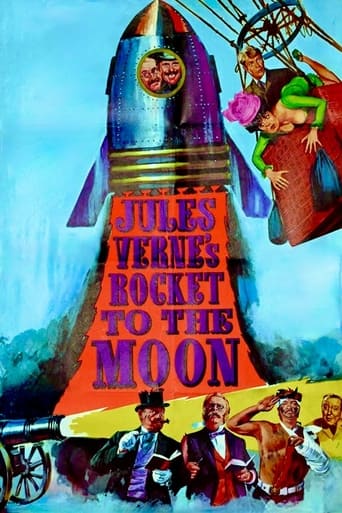
Jules Verne's Rocket to the Moon (1967)
Phineas T. Barnum and friends finance the first flight to the moon but find the task a little above them. They attempt to blast their rocket into orbit from a massive gun barrel built into the side of a Welsh mountain, but money troubles, spies and saboteurs ensure that the plan is doomed before it starts...
- Date of release
- 1967-07-13
- TMDB
- 5.5 / 10 (34)
- Runtime
- 1h 59m
- Genres
- Comedy, Adventure, Fantasy
- Director
- Don Sharp
Casting
- Burl Ives — Phineas T. Barnum
- Troy Donahue — Gaylord Sullivan
- Gert Fröbe — Professor Siegfried von Bulow
- Hermione Gingold — Angelica
- Lionel Jeffries — Sir Charles Dillworthy
- Dennis Price — The Duke of Barset
- Daliah Lavi — Madelaine
- Stratford Johns — Warrant Officer
- Graham Stark — Bertram Grundle
- Terry-Thomas — Captain Sir Harry Washington-Smythe
- Renate von Holt — Anna Lindstrom
- Jimmy Clitheroe — General Tom Thumb
Interesting facts
- Based on: From the Earth to the Moon
Jules Verne's Rocket to the Moon is a 1967 British science fiction comedy film directed by Don Sharp and starring Burl Ives, Troy Donahue, Gert Fröbe and Terry-Thomas.
Production
Towers (as "Peter Welbeck") devised the story, very loosely based on the 1865 novel From the Earth to the Moon by Jules Verne, whilst the script was by Dave Freeman, a comedy writer for The Benny Hill Show. Don Sharp, who eventually directed the film, said Freeman's original script was "glorious" which encouraged Towers to make an all-star film.
The film was originally announced as going to star Bing Crosby as Phineas T. Barnum and Senta Berger, along with Terry-Thomas, Gert Fröbe and Wilfred Hyde-White. AIP said it would be a "wild adventure laced with comedy." In the end Lionel Jeffries replaced Hyde-White and Burl Ives and Daliah Lavi stood in for Crosby and Berger.
"The cast just grew and grew," recalled Sharp, "so the cost became bigger than the original budget." Sharp says this meant the script was rewritten to accommodate stars who could raise finance. He said what had been "a glorious, tight 100 minutes of comedy grew and grew and it got unwieldy."
The film was almost entirely shot in Ireland starting 6 August 1966. The rocket launch was shot at the site of a disused copper mine in Avoca in Co.Wicklow, other exterior scenes were shot in the sand dunes of Brittas Bay, and the interior scenes were shot at Ardmore Studios, just south of Dublin.
Director Don Sharp who had made several films for the producer Harry Alan Towers recalled that the film was Towers' most expensive. Attempting to obtain more funds for the projected US$3 million budget, Towers approached several international film studios who planned to release the films in their home countries; Constantin Film in West Germany, Anglo-Amalgamated in Great Britain and American International Pictures in the United States of America.…
Read on Wikipedia · Text from Wikipedia, CC BY-SA 4.0. Data from Wikidata.
Recommended
- Over the Moon 2020 · ★ 7.2
- Slumberland 2022 · ★ 7.2
- Secret Society of Second-Born Royals 2020 · ★ 6.6
- The Monkey King 2023 · ★ 6.5
- The Borrowers 1997 · ★ 6.0
- My Little Pony: Equestria Girls - Legend of Everfree 2016 · ★ 7.5
- Stewie Griffin: The Untold Story 2005 · ★ 6.9
- Kermit's Swamp Years 2002 · ★ 5.8
- Rugrats Go Wild 2003 · ★ 6.4
- Tom and Jerry & The Wizard of Oz 2011 · ★ 6.2
- Shorts 2009 · ★ 5.9
- The Brave Little Toaster to the Rescue 1997 · ★ 6.1