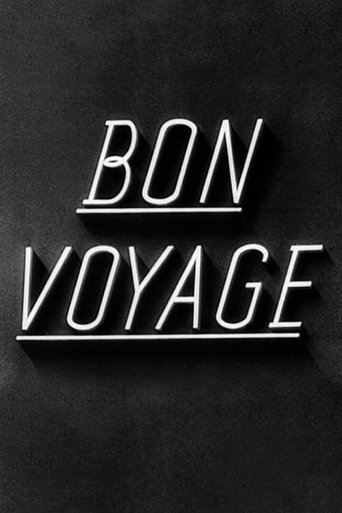
Călătorie bună (1944)
Bon Voyage
After escaping a Nazi POW camp, a young Scottish RAF gunner recounts his perilous journey through occupied France with the help of the Resistance. During his debriefing in London, French intelligence officers press him for details—especially about one companion whose true loyalties may not be what they seemed.
- Data lansării
- 1944-01-01
- TMDB
- 5.6 / 10 (76)
- Durată
- 26 min
- Genuri
- Război, Dramă
- Regizor
- Alfred Hitchcock
Distribuție
- John Blythe — John Dougall
- Janique Joelle — Jeanne
Curiozități
Bon Voyage is a 1944 short French language propaganda film directed by Alfred Hitchcock for the British Ministry of Information. It was written by Angus MacPhail and J.O.C. Orton.
Production
Hitchcock had offered his services to the British government after his former producer in the UK, Michael Balcon, made a statement about overweight British directors who had left the country for Hollywood "while we who are left behind short-handed are trying to harness the films to our great national effort." Later, Hitchcock told François Truffaut "I felt the need to make a little contribution to the war effort, and I was both overweight and ove…
Hitchcock soon began development of Bon Voyage, which he described as "a little story about an RAF man who is being escorted out of France through the Resistance channels. His escort was a Polish officer. When he arrives in London, the RAF man is interrogated by an officer of the Free French Forces, who informs him that his Polish escort was really a Gestapo man.
Hitchcock cast John Blythe in the lead role, and the remaining members of the cast came from the Molière Players, who had escaped from France after the German invasion, and whose names were not revealed so as to protect their relatives still in France.
Bon Voyage was filmed from 20 January to 25 February at Associated British Studios. Hitchcock was paid £10 a week.
It is uncertain whether Bon Voyage – which was a disappointment as a propaganda film to the Ministry of Information – was ever shown in Britain or in France. It and Aventure malgache (1944) were shelved by the Ministry and were not seen again until the 1990s, when they were restored by the British Film Institute.
Citește pe Wikipedia · Text din Wikipedia, CC BY-SA 4.0. Date din Wikidata.
Recomandate
- The Sea Wolves 1980 · ★ 5.9
- The Desert Fox: The Story of Rommel 1951 · ★ 6.7
- 36 de ore 1964 · ★ 7.1
- Night Train to Munich 1940 · ★ 7.2
- Darkest Hour: Ziua decisivă 2017 · ★ 7.4
- Marea evadare 1963 · ★ 7.9
- Churchill 2017 · ★ 6.2
- 13 Rue Madeleine 1947 · ★ 6.2
- Act of Violence 1949 · ★ 6.9
- The Secret Invasion 1964 · ★ 5.8
- Tobruk 1967 · ★ 6.4
- Journey into Fear 1943 · ★ 6.1