The Cavalier's Dream (1898)
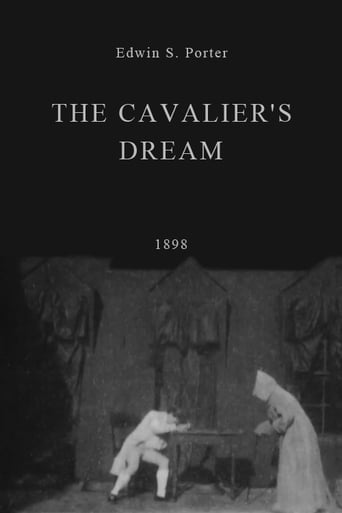
He sits asleep at a bare table; old witch enters, raps three times, then disappears; cavalier sees table spread for a sumptuous repast. Mephistopheles appears; then the old witch, who suddenly changes to a beautiful young girl. The changes and magical appearances are startling and instantaneous.
- Date of release
- 1898-12-22
- TMDB
- 4.7 / 10 (20)
- Runtime
- 1m
- Genres
- Horror, Fantasy
- Director
- J. Stuart Blackton, Albert E. Smith
Interesting facts
The Cavalier's Dream is an 1898 American silent horror trick film. This Edison-Vitagraph short was not widely circulated in its time, but was preserved for the Library of Congress in 1958. In 2017, the Library scanned the 16mm film and the 2K file was published on the Internet Archive.
Production and reproduction
In 1897, theatrical entertainers Blackton and Smith incorporated an Edison motion-picture projector into their "Edison Vitagraph" stage act. By year's end, they converted the machine into a movie camera, and by 1898 were shooting actualities, comedies, advertisements, and trick films.
As had recently become standard practice, Edison's company used the 35mm film negative to print each frame onto rolls of photographic paper, also 35mm wide. Two copies of the paper prints were deposited with the U.S. Copyright Office as legal proof of rights ownership. The Cavalier's Dream was not a well-known film and was seldom written about.
An excerpt from the Edison-Vitagraph production appears at the beginning, middle, and end of Bill Morrison (director)'s experimental narrative, The Film of Her (1996, 12 minutes). Without having seen the movie, Morrison purchased a 16mm copy from the Library, based on the Dream title.
In 2025, composer Anping Chen (NYU Screen Scoring Program) recorded his original score for The Cavalier's Dream. This version of the movie premiered at the Bill Morrison retrospective, held at the Nickelodeon Theater in Columbia, South Carolina, March 30–31, 2025.
Read on Wikipedia · Text from Wikipedia, CC BY-SA 4.0. Data from Wikidata.
Recommended
- A Knight's War 2025 · ★ 6.2
- Abraham Lincoln Vampire Hunter: The Great Calamity 2012 · ★ 8.1
- Pumpkinhead 1988 · ★ 6.4
- The Adventures of Ichabod and Mr. Toad 1949 · ★ 6.5
- Pirates of the Caribbean: Tales of the Code: Wedlocked 2011 · ★ 6.7
- They Reach 2020 · ★ 6.8
- Monster High: Frights, Camera, Action! 2014 · ★ 7.5
- Ginger Snaps 2000 · ★ 6.9
- Werewolf by Night 2022 · ★ 7.0
- Monster 2005 · ★ 6.7
- Vicious 2025 · ★ 6.0
- Terrifier 2011 · ★ 6.0