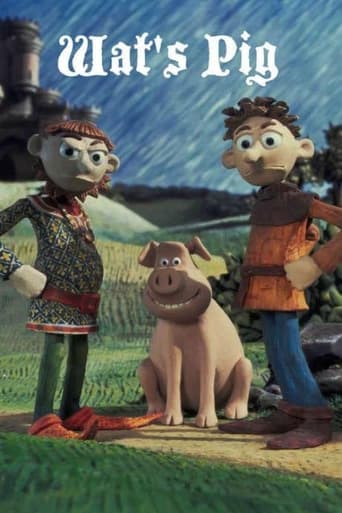
Wat's Pig (1996)
In a Medieval castle, a marauder tries to kidnap the twin infant sons of the lord. He makes off with only one, whom he drops about a mile away. A pig rescues this baby, so one brother grows up high on the hog, the other down with the swine; one is lazy, his lost brother is industrious. Years later, when a neighboring prince declares war, the brother in the castle is too soft to fight. Through happenstance, the twins are united just before the final battle. Will the upper-class brother let his humble sibling lead the troops to certain defeat and death? Preserved by the Academy Film Archive.
- Data de estreia
- 1996-04-10
- TMDB
- 6.8 / 10 (19)
- Duração
- 11 min
- Géneros
- Animação
- Realizador
- Peter Lord
Curiosidades
- Prémios: 0 · Nomeações: 1
Wat’s Pig is a 1996 British stop-motion animated short film created by Aardman Animations and written and directed by Peter Lord. It is a tale of two brothers who are separated as babies only to reunite as adults during a war. It is told almost entirely non-verbally. It is based loosely on the story of The Prince and the Pauper.
Production
According to the crew, Wat's Pig was "shown first to all the Aardman people in a studio premiere without benefit of spotlights and starlets. Since then it's been shown at many short film festivals, and was then included in the Aardman Collection (which has been touring the world's cinemas very successfully)". They described it as a "long slow haul making Wat's Pig. The idea started...on holiday in the Dordogne region of France.
Wat's Pig was Aardman's sixth Academy Award nomination, and Lord's second Academy Award nomination as a director.
Peter Lord said: "I don't expect, Wat's Pig to make its money back, or Stage Fright to make its money back, but we have that luxury. We can do that here, because we get money from the commercials and the merchandising malarkey."
He explained some of the production process:
As a concept, it was in there right from the start. I think it is interesting as a way with story telling, not just as a technical exercise. I think about Paul Driessen's film, The End of the World in Four Seasons, a similar storytelling approach. There was a time when I thought of doing more of the film in split-screen, not the whole film, but more with split-screen, but that [idea] slowly eroded as I worked on the storyboards.
Ler na Wikipédia · Texto da Wikipédia, CC BY-SA 4.0. Dados do Wikidata.
Recomendados
- Animal Farm 2026 · ★ 6.3
- The Pied Piper 1933 · ★ 6.5
- Winnie the Pooh and the Blustery Day 1968 · ★ 7.3
- Academia Cranston - Cenas Monstruosas! 2020 · ★ 6.0
- Classicos de Encantar: Os Três Porquinhos 1933 · ★ 6.9
- Sem Tempo para Nozes 2006 · ★ 7.4
- Os Willoughby 2020 · ★ 7.1
- Jimmy Timmy Power Hour 2004 · ★ 7.1
- Babes in the Woods 1932 · ★ 6.1
- Koati - Aventura na Selva 2021 · ★ 7.1
- Dragões: A Origem das Corridas de Dragão 2014 · ★ 7.2
- Os Três Lobinhos 1936 · ★ 6.6