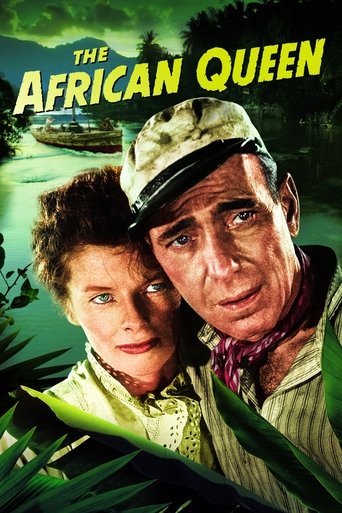
The African Queen (1952)
The greatest adventure a man ever lived… with a woman!
At the start of the First World War, in the middle of Africa’s nowhere, a gin soaked riverboat captain is persuaded by a strong-willed missionary to go down river and face-off a German warship.
- Date of release
- 1952-01-07
- TMDB
- 7.3 / 10 (1114)
- Runtime
- 1h 45m
- Genres
- Adventure, Romance, War, Drama
- Director
- John Huston
Casting
- Humphrey Bogart — Charlie Allnut
- Katharine Hepburn — Rose Sayer
- Robert Morley — The Brother
- Peter Bull — Captain of Louisa
- Theodore Bikel — First Officer
- Walter Gotell — Second Officer
- Peter Swanwick — First Officer of Shona
- Richard Marner — Second Officer of Shona
Interesting facts
- Based on: The African Queen
- Filmed in: Democratic Republic of the Congo and Turkey
- Awards: 1 · Nominations: 4. Including: Academy Award for Best Actor
The African Queen is a 1951 adventure film adapted from the 1935 novel of the same name by C. S. Forester. It was directed by John Huston and produced by Sam Spiegel, and John Woolf. The screenplay was adapted by James Agee, John Huston, John Collier and Peter Viertel. It was photographed in Technicolor by Jack Cardiff and has a music score by Allan Gray. The film stars Humphrey Bogart and Katharine Hepburn with Robert Morley, Peter Bull, Walter Gotell, Richard Marner, and Theodore Bikel.
Production
Production censors objected to several aspects of the original script, such as the unmarried characters Charlie Allnut and Rose Sayer cohabiting on the boat (as in the C. S. Forester book), and some changes were made before the film was completed.
The film was partially financed by John and James Woolf of Romulus Films, a British company. Michael Balcon, an advisor to the National Film Finance Corporation, advised the NFFC to refuse a loan to the Woolfs unless the film starred his former Ealing Studios actors John McCallum and Googie Withers rather than Humphrey Bogart and Katharine Hepburn, whom the Woolfs wanted.
The cast and crew assembled in Africa in December 1950 and much of the film was shot in Lake Albert, Uganda, and in Ubundu, of the Belgian Congo in Africa. This was rather novel for the time, especially for a Technicolor picture that used large, cumbersome "Three-Strip" cameras. The cast and crew endured sickness and spartan living conditions during their time on location.
About half of the film was shot in the UK. The scenes in which Bogart and Hepburn are seen in the water were all shot in studio tanks at Worton Hall Studios in Isleworth, near London. These scenes were considered too dangerous to shoot in Africa. All of the foreground plates for the process shots were also filmed in studio.
Scenes on the boat were filmed using a large raft with a mockup of the boat on top. Sections of the boat set could be removed to make room for the large Technicolor camera. This proved hazardous on one occasion when the boat's boiler, a heavy copper replica, almost fell on Hepburn. It was not secured to the deck because it also had to be moved to accommodate the camera.
Read on Wikipedia · Text from Wikipedia, CC BY-SA 4.0. Data from Wikidata.
Recommended
- Indivisible 2018 · ★ 7.0
- Adrift 2018 · ★ 6.8
- Kensuke's Kingdom 2024 · ★ 7.1
- Rob Roy 1995 · ★ 6.7
- Out of Africa 1985 · ★ 7.1
- The Big Sky 1952 · ★ 6.6
- Love's Enduring Promise 2004 · ★ 6.8
- The Other Side of Heaven 2001 · ★ 6.3
- The Inn of the Sixth Happiness 1958 · ★ 6.8
- Australia 2008 · ★ 6.6
- Summerland 2020 · ★ 7.5
- On Fire 2023 · ★ 6.3