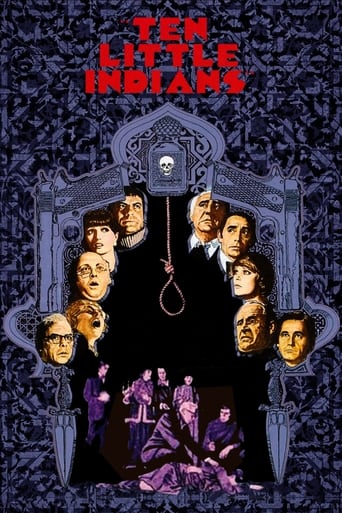
열 개의 인디언 인형 (1974)
And Then There Were None
Ten people are invited to a hotel in the Iranian desert, only to find that an unseen person is killing them one by one. Could one of them be the killer?
- 개봉일
- 1974-09-24
- TMDB
- 5.7 / 10 (119)
- 상영 시간(분)
- 1시간 38분
- 장르
- 범죄, 드라마, 미스터리, 공포
- 감독
- Peter Collinson
출연진
- 올리버 리드 — Hugh Lombard
- 앨케 조머 — Vera Clyde
- 리처드 애튼버러 — Judge Arthur Cannon
- 스테판 오드랑 — Ilona Morgan
- 게르트 프뢰베 — Wilhelm Blore
- Herbert Lom — Dr. Edward Armstrong
- Maria Rohm — Elsa Martino
- 아돌포 셀리 — General André Salvé
- Alberto de Mendoza — Otto Martino
- 샤를 아즈나부르 — Michel Raven
- 오슨 웰스 — Voice on Tape
- Naser Malek Motiee — Inspector
흥미로운 사실
- 원작: 그리고 아무도 없었다
And Then There Were None is a 1974 mystery film and an adaptation of Agatha Christie's best-selling 1939 mystery novel of the same name. The film was directed by Peter Collinson and produced by Harry Alan Towers. This was the fourth of five versions of Christie's novel to be adapted to the screen and the second from producer Harry Alan Towers. Two film adaptations were previously released. An American made-for-television version was broadcast in 1959. Towers produced a third version in 1989.
Production
The 1974 film reuses the script of the 1965 version, even calling Oliver Reed's character "Hugh" instead of "Phillip," which was the character's name in the novel and play. It is set in an abandoned hotel in the Iranian desert.
Herbert Lom, who plays Dr. Armstrong in this film, also starred in the 1989 version, as the General (played by Adolfo Celi in this version).
Much of the film was shot on location in pre-revolution Iran. It is set at a massive, fictional hotel in the desert, adjacent to the ruins of Persepolis.
Interior scenes were filmed at the Shah Abbas Hotel in Isfahan. The nearby Shah Mosque served as the hotel's exterior and main entrance. Wide shots of the hotel, next to the ruins, are effects shots combining photography of the mosque and the ruins. Portions of the film were shot within the ruins of Persepolis, and the famous terrace of the Ālī Qāpū palace, in Isfahan, is made to appear to be part of the ruins.
The European cut of the film featured a pre-credit sequence that showed the guests arriving by plane before boarding a helicopter to be transported to the hotel. However, this prologue was cut from the US release.
위키백과에서 더 읽기 · 텍스트 출처: 위키백과, CC BY-SA 4.0. 데이터 출처: Wikidata.
추천
- 보이 2015 · ★ 5.8
- 계시록 2025 · ★ 6.4
- 서버비콘 2017 · ★ 5.9
- 악마들은 모두 여기에 2025 · ★ 6.2
- 할렘 덩크 1994 · ★ 7.0
- 더 데블 유 노우 2022 · ★ 6.7
- 퍼블릭 아이 1992 · ★ 6.2
- 워킹 톨 3 2007 · ★ 5.8
- Panic 2000 · ★ 6.2
- Nature of the Beast 1995 · ★ 5.9
- 블랙 사이트 2022 · ★ 6.0
- Miss Marple: A Caribbean Mystery 1989 · ★ 6.7