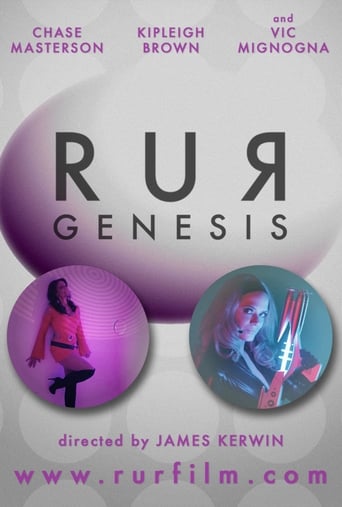
R.U.R. Genesis (2013)
A story of robots leading a revolution against their human creators. It explores dehumanization through technology and the failure of a technologically driven utopia.
- Date of release
- 2013-09-13
- Runtime
- 7m
- Genres
- Science Fiction, Action, Drama
- Director
- James Kerwin
Casting
- Amara Cash
- Chase Masterson
- Kipleigh Brown
- James Ellis Lane
- John Champion
- Mary Czerwinski
- Vanessa Loret
- Jason Weiss
- Frederic Jean
- Shadii
- Meg Wolf
- Vic Mignogna
Interesting facts
R.U.R. is a 1920 science fiction play by the Czech writer Karel Čapek. "R.U.R." stands for Rossumovi Univerzální Roboti.
Production history and translations
The work was published in two differing versions in Prague by Aventinum, first in 1920, followed by a revised version in 1921. After being postponed, it premiered at the city's National Theatre on 25 January 1921, although an amateur group had by then already presented a production.
By 1921, Paul Selver translated either the original 1920 edition of R.U.R. or a manuscript copy close to this version into English. He probably translated the play freelance, and sold it to St Martin's Theatre in London. Selver's translation was adapted for the British stage by Nigel Playfair in 1922, but it was not produced straight away. Later that year performance rights for the U.S.
The American première was produced by the Theatre Guild at the Garrick Theatre in New York City in October 1922, where it ran for 184 performances. In the first performance, Domin was portrayed by Basil Sydney, Marius by John Merton, Hallemeier by Moffat Johnston, Alquist by Louis Calvert, Busman by Henry Travers, the robot Helena by antiwar activist Mary Crane Hone in her Broadway debut, and Primus by John Roche.
In April 1923 Basil Dean produced R.U.R. in Britain for the Reandean Company at St Martin's Theatre, London. This version was based on Playfair's adaptation, but omitted the characters Fabry and Hallemeier, and included several of the New York Theatre Guild revisions.
In the 1920s, the play was performed in a number of American and British cities, including the Theatre Guild "Road" in Chicago and Los Angeles during 1923.
Read on Wikipedia · Text from Wikipedia, CC BY-SA 4.0. Data from Wikidata.
Recommended
- 2073 2024 · ★ 6.7
- Code 8 Part II 2024 · ★ 6.4
- Monsters of Man 2020 · ★ 6.4
- Doctor Who: The Night of the Doctor 2013 · ★ 8.0
- Ghost Recon: Alpha 2012 · ★ 7.2
- Peter's To-Do List 2019 · ★ 7.0
- Babylon 5: The Legend of the Rangers - To Live and Die in Starlight 2002 · ★ 6.0
- Vesper 2022 · ★ 6.2
- Matriculated 2003 · ★ 6.6
- The Congress 2013 · ★ 6.4
- Stormageddon 2015 · ★ 6.0
- Final Flight of the Osiris 2003 · ★ 6.9