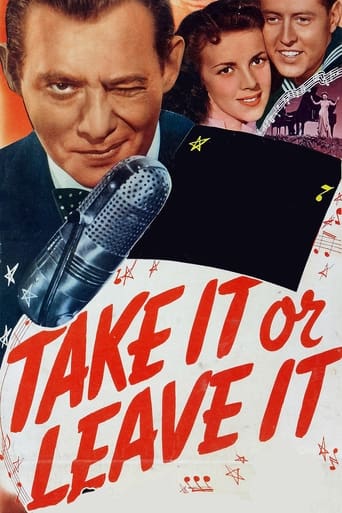
Take It or Leave It (1944)
Surprise hit!!! See all your favorite stars as you love them best
A young husband becomes a game-show participant in the hopes of winning the cash to pay his pregnant wife's doctor.
- Date of release
- 1944-07-17
- TMDB
- 6.0 / 10 (2)
- Runtime
- 1h 10m
- Director
- Benjamin Stoloff
Casting
- Phil Baker — Phil Baker
- Madge Meredith — Kate Collins
- Nana Bryant — Miss Burke
- Nella Walker — Mrs. Preston
- Roy Gordon — Dr. Edward Preston
- Frank Jenks — Cab Driver
- Renie Riano — Mrs. Nellie Bramble
- Frankie Darro — Radio Listener
- Edward Ryan — Eddie Collins
- Stanley Prager — Herb Gordon
- Carleton Young — Program Director
- Billie Seward — Nurse
Interesting facts
Take It or Leave It is a 1944 American musical-comedy film directed by Benjamin Stoloff and written by Mac Benoff, Harold Buchman, and Snag Werris. It was the screen version of the popular radio quiz show of the same name, whose main feature was "the $64 question." Master of ceremonies Phil Baker played himself in the movie.
Production and reception
Take It or Leave It was produced on an exceptionally low budget for a major-studio motion picture. Twentieth Century-Fox producer Bryan Foy economized by casting inexpensive juveniles in principal roles (Edward Ryan, Marjorie Massow—later known as Madge Meredith—and Stanley Prager), with only a few character players in support and bit roles.
Bryan Foy slashed the budget even more by inserting entire chunks of old Fox movies into the narrative. Most of the film has Phil Baker asking contestant Edward Ryan questions about famous motion pictures of the past, and each question is accompanied by a production number shown on a screen. Thus Shirley Temple, Alice Faye, Betty Grable, Buster Keaton, Al Jolson, The Ritz Brothers, and other Fox stars make appearances.
Although three screenwriters are credited, the storyline is very slight. The three writers were really radio jokesmiths, hired to supply star Phil Baker with a running repertoire of puns and one-liners appropriate to each quiz question.
The film was released on July 7, 1944. Fox did not publicize the star names in the cast, inviting the audience to play along with the quiz game and be surprised by the film clips. It was a shrewd strategy and a daring gamble, since such a mixture of old and new film footage was unprecedented.
Read on Wikipedia · Text from Wikipedia, CC BY-SA 4.0. Data from Wikidata.
Recommended
- A Big Hand for the Little Lady 1966 · ★ 7.1
- Fun with Dick and Jane 1977 · ★ 6.6
- The River 1984 · ★ 6.4
- Beverly Hills Chihuahua 2 2011 · ★ 5.9
- Flicka 2006 · ★ 6.9
- Fast Girls 2012 · ★ 6.0
- Blue Chips 1994 · ★ 6.1
- Rookie of the Year 1993 · ★ 6.2
- The Magic of Ordinary Days 2005 · ★ 7.5
- The Words 2012 · ★ 6.7
- Buffaloed 2020 · ★ 6.6
- Overboard 1987 · ★ 6.9