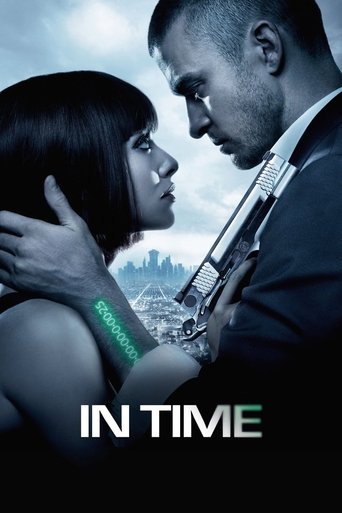
In Time (2011)
Live forever or die trying.
In the not-too-distant future, the aging gene has been switched off. To avoid overpopulation, time has become the currency and the way people pay for luxuries and necessities. The rich can live forever, while the rest struggle to negotiate for their immortality. A poor young man who suddenly comes into a fortune of time finds himself on the run from a corrupt police force known as the "time keepers".
- Date of release
- 2011-10-27
- TMDB
- 7.0 / 10 (12624)
- Runtime
- 1h 49m
- Genres
- Action, Thriller, Science Fiction
- Director
- Andrew Niccol
Casting
- Amanda Seyfried — Sylvia Weis
- Justin Timberlake — Will Salas
- Cillian Murphy — Raymond Leon
- Vincent Kartheiser — Philippe Weis
- Olivia Wilde — Rachel Salas
- Matt Bomer — Henry Hamilton
- Johnny Galecki — Borel
- Collins Pennie — Timekeeper Jaeger
- Toby Hemingway — Timekeeper Kors
- Brendan Miller — Kolber
- Yaya DaCosta — Greta
- Alex Pettyfer — Fortis
Interesting facts
- Box office: $173.9M
- Budget: $40M
- Earned 4.3× its budget
- Filmed in: Los Angeles
In Time is a 2011 American science fiction action film written, co-produced, and directed by Andrew Niccol. Justin Timberlake and Amanda Seyfried star as inhabitants of a dystopian future where time is its primary currency; each individual possesses a subdermal tattoo-like countdown digital clock on their left forearm that kills them when they 'time out'. Cillian Murphy, Vincent Kartheiser, Olivia Wilde, Matt Bomer, Johnny Galecki, and Alex Pettyfer costar. The film was released on October 28, 2011, and grossed $174 million against a $40 million budget. It received mixed reviews from critics, who praised the premise while criticizing its execution.
Production
Before the film was titled In Time, the names Now and I'm.mortal were used. In July 2010, both Amanda Seyfried and Justin Timberlake had been offered the lead roles, officially signing on at the end of the month. On August 9, 2010, Cillian Murphy was confirmed to have joined the cast.
The first photos from the set were revealed on October 28, 2010. 20th Century Fox and New Regency distributed the film, and Marc Abraham and Eric Newman's Strike Entertainment produced it.
In an interview with Kristopher Tapley of In Contention, Roger Deakins stated that he would be shooting the film in digital, which makes this the first film to be shot in digital by the veteran cinematographer.
The use of retrofuturism is one of many elements that the film shares with Niccol's earlier work, Gattaca; Niccol himself referred to it as "the bastard child of Gattaca".
Read on Wikipedia · Text from Wikipedia, CC BY-SA 4.0. Data from Wikidata.
Recommended
- Next 2007 · ★ 6.2
- RoboCop 2014 · ★ 5.9
- Paycheck 2003 · ★ 6.2
- Time Lapse 2014 · ★ 6.5
- Primer 2004 · ★ 6.7
- Overdrive 2017 · ★ 6.1
- Gemini Man 2019 · ★ 6.3
- Surrogates 2009 · ★ 6.2
- Stormageddon 2015 · ★ 6.1
- The Hunger Games 2012 · ★ 7.2
- Terminator Genisys 2015 · ★ 6.0
- Indemnity 2022 · ★ 6.6