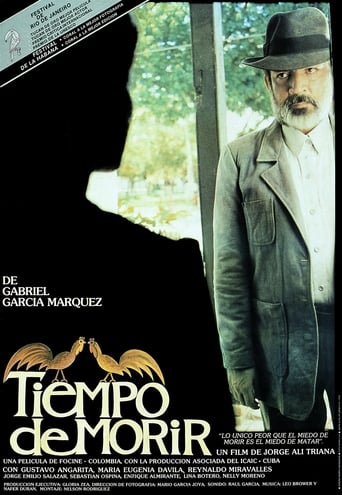
A Time to Die (1986)
Tiempo de morir
A man is released from prison, and after 18 years, returns to his village. But in this village, time, in many ways, has stood still. The time served by Juan complied with the court's justice, but not with some villagers. There are some who still seek true justice.
- Date of release
- 1986-04-15
- TMDB
- 6.9 / 10 (10)
- Runtime
- 1h 38m
- Genres
- Action, Crime, Drama
- Director
- Jorge Alí Triana
Casting
- Gustavo Angarita — Juan Sayago
- Sebastian Ospina — Julian Moscote
- Jorge Emilio Salazar — Pedro Moscote
- María Eugenia Dávila — Mariana
- Lina Botero — Sonia
- Enrique Almirante — Mayor
- Mónica Silva — Sonia's Mother
- Héctor Rivas — Don Tulio
- Luis Chiape — Hairdresser
- Reynaldo Miravalles — Casildo
- Lucy Martínez — Rosa
- Edgardo Román — Diego
Interesting facts
- Awards: 0 · Nominations: 1
A Time to Die, also called Time to Die, is a 1985 Colombian drama film directed by Jorge Alí Triana and starring Gustavo Angarita, María Eugenia Dávila and Sebastián Ospina. The script, written by Colombia's Nobel Prize-winning author Gabriel García Márquez, had been shot twice before, first in 1965 by Mexican director, Arturo Ripstein and in 1982 also by Jorge Alí Triana as a TV series produced by RTI Producciones.
Production
A Time to Die was written for the screen by Gabriel García Márquez in the 1960s in Mexico. Carlos Fuentes collaborated with the dialogues, incorporating Mexican slang. The film, shot in the style of a western, was made in 1966 by Mexican director Arturo Ripstein in his debut as film director.
In 1984 the story was remade as a television miniseries for RTI in Colombia, under the direction of Jorge Alí Triana. Triana worked on the script's dialogues with the help of Eligio García Márquez (1947–2001), a brother of the Nobel Prize winner writer. This television production had the same main cast of this film (Gustavo Angarita, María Eugenia Dávila, Sebastián Ospina and Jorge Emilio Salazar), and it was well received by critics.
The film retakes the story of the original script, but incorporates a new key scene written by García Márquez specially for this version. Triana wanted to showcase the fear of the character of Julian Moscote, the oldest brother developing the theme that worse than the fear of dying is the fear of killing. One week before production started, the Nobel prize winner wrote the scene in which the prostitute reads Julian his fortune in the cards.
The film was a production between Colombia and Cuba, made with a budget of 300,000 dollars. Focine, the Colombian Institutional Company of Cinematography, gave 200,000 and el Instituto Cubano de Arte e Industria Cinematográficos, ICAIC, contributed 100,000 dollars. It was photographed by Cuban cameraman Mario Garcia Joya and it was edited in La Habana.
While working in the post-production of the film in Cuba, Jorge Alí Triana saw Ripstein's version for the first time. The two films are very different in style and approach. Ripstein's predecessor resembles more the classical American western as a revenge drama. Triana's film reflects more the tropical flavor that Gabriel García Márquez intended. It is less symbolic that Ripstein's film and more of a denunciation of Latin American machismo.
Read on Wikipedia · Text from Wikipedia, CC BY-SA 4.0. Data from Wikidata.
Recommended
- Convict 2014 · ★ 6.5
- The Enforcer 2022 · ★ 7.0
- The Parts You Lose 2019 · ★ 6.7
- The Perfect Weapon 1991 · ★ 6.4
- Take Back 2021 · ★ 5.9
- Silverton Siege 2022 · ★ 6.3
- The Double 2011 · ★ 5.8
- The System 2022 · ★ 7.3
- Redeemer 2014 · ★ 6.2
- Hellhound 2024 · ★ 6.8
- Black Site 2022 · ★ 6.0
- Empire 2002 · ★ 6.2