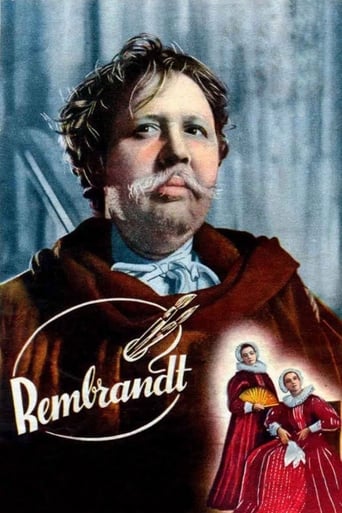
Rembrandt (1936)
He knew all women! Their lives...Loves...Their souls!
A character study depicting the life of Rembrandt Van Rijn at the height of his fame in the mid 1600s. Beginning with the death of his wife, Rembrandt's work takes a dark turn, which offends many of his patrons.
- Date of release
- 1936-11-06
- TMDB
- 6.8 / 10 (38)
- Runtime
- 1h 25m
- Genres
- Drama, History
- Director
- Alexander Korda
Casting
- Charles Laughton — Rembrandt van Rijn
- Gertrude Lawrence — Geertje Dirx
- Elsa Lanchester — Hendrickje Stoffels
- Edward Chapman — Fabrizius
- Walter Hudd — Capt. Banning Cocq
- Roger Livesey — Beggar Saul
- John Bryning — Titus van Rijn
- Sam Livesey — Auctioneer
- Herbert Lomas — Harmenzs van Rijn
- Allan Jeayes — Dr. Tulp
- John Clements — Govaert Flinck
- Raymond Huntley — Ludwick
Interesting facts
Rembrandt is a 1936 British biographical film made by London Film Productions of the life of 17th-century Dutch painter Rembrandt van Rijn. The film was produced and directed by Alexander Korda from a screenplay by June Head and Lajos Bíró based on a story by Carl Zuckmayer. The music score was by Geoffrey Toye and the cinematography by Georges Périnal.
Production
Alexander Korda had previously worked with Laughton on The Private Life of Henry VIII— a hit “on both sides of the Atlantic”—and wanted to re-create that success.
In an article on TCM.com, Seattle Times critic Sean Axmaker describes the detailed preparations for the film, which included Korda and Laughton's repeated trips to Holland and Laughton's taking up painting and growing a mustache. “There were problems on the set, notably a clash with stage legend Gertrude Lawrence...
Laughton's wife, Elsa Lanchester, noted in her autobiography that Lawrence "despised films so much that she wouldn't even attempt to learn the words" and wrote her lines on the large white cuffs of her costumes or on the back of a chair.
According to a Laughton biography, Laughton had set designer Vincent Korda and costume designer John Armstrong teach him how to create the illusion of painting. Lanchester reports that Laughton visited Holland several times before shooting began and went to every museum that had Rembrandt paintings.
Lanchester plays Hendrickje, Rembrandt's maid and model, who becomes his lover and bears his daughter. Lanchester composed the music and lyrics for “Hendrickje's Theme”.
Read on Wikipedia · Text from Wikipedia, CC BY-SA 4.0. Data from Wikidata.
Recommended
- Radium Girls 2020 · ★ 6.6
- The Current War 2018 · ★ 6.7
- Copying Beethoven 2006 · ★ 6.5
- Julia 1977 · ★ 6.5
- At Eternity's Gate 2018 · ★ 7.0
- The Book of Daniel 2013 · ★ 7.0
- Final Portrait 2017 · ★ 6.0
- The Life of Emile Zola 1937 · ★ 6.7
- Viceroy's House 2017 · ★ 6.7
- Mansfield Park 2007 · ★ 6.1
- All Is True 2018 · ★ 6.0
- Marie Antoinette 2006 · ★ 6.7