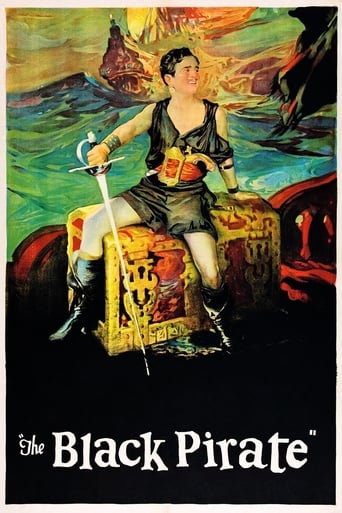
The Black Pirate (1926)
The Love Story of a Bold Buccaneer
A nobleman vows to avenge the death of his father by the hands of pirates. To this end, he infiltrates the pirate band; Acting in character, he single-handedly captures a merchant vessel, but things are complicated when he finds that there is a beautiful young woman of royal blood aboard.
- Date of release
- 1926-03-08
- TMDB
- 6.7 / 10 (62)
- Runtime
- 1h 34m
- Genres
- Adventure, Drama, Action
- Director
- Albert Parker
Casting
- Douglas Fairbanks — The Duke of Arnoldo / The Black Pirate
- Billie Dove — Princess Isobel
- Anders Randolf — Pirate Captain
- Donald Crisp — MacTavish
- Tempe Pigott — Duenna (as Tempe Pigett)
- Sam De Grasse — Pirate Lieutenant
- Charles Stevens — Powder Man
- John Wallace — Peg-Leg Pirate
- Fred Becker — Pirate
- Charles Belcher — Chief Passenger - Nobleman
- E.J. Ratcliffe — The Governor
- Nino Cochise — Pirate (uncredited)
Interesting facts
The Black Pirate is a 1926 American silent color adventure film directed by Albert Parker, starring Douglas Fairbanks, Billie Dove, Donald Crisp, Sam De Grasse, and Anders Randolf.
Production
The Black Pirate is considered "one of the silent films that is best remembered" Part of that reputation is based on the plot, but above all on the fact that it was one of the first films shot with the Technicolor two-tone process, which was rare and very expensive at the time.
However, the film is far from being the first to use colors. These have been present since the earliest days of cinema, not to perfect an illusion of realism, but as an ornamental and spectacular attraction. In 1926, when Fairbanks' film was released, 80 to 85% of film productions featured color effects, mainly by tinting or toning.
Technicolor Process No. 2 used for Fairbanks' film is a process for rendering natural colors by duotone developed in 1921 and which represented a significant improvement over Technicolor No. 1, for which the Technicolor company had been established in 1915. Process No.
The Black Pirate is not the first subtractive duotone fiction film; however, this primacy belongs to The Glorious Adventure, directed by James Stuart Blackton in Prizma Color and released in 1922. It was also not the first film made entirely in Technicolor No. 2, since it was preceded by Chester M. Franklin's The Toll of the Sea, a medium-length film also released in 1922 and produced by the Technicolor company to promote its process.
The Toll of the Sea, on the other hand, has a well-defined and stable image, with bright orange and red tones, but a tendency towards brown and impasto in the rendering of vegetal exteriors and distances. Repeating the choices of the inventors of Kinemacolor, Technicolor's engineers prioritize skin tones and sacrifice the blue of the sea and sky, which leads to a "paradoxical coexistence of the natural and the ornamental".
Read on Wikipedia · Text from Wikipedia, CC BY-SA 4.0. Data from Wikidata.
Recommended
- Strings 2004 · ★ 6.6
- Mythica: A Quest for Heroes 2014 · ★ 5.9
- Robin Hood 1922 · ★ 6.4
- Pinocchio 2009 · ★ 6.1
- True Spirit 2023 · ★ 7.0
- Dirt 2018 · ★ 6.1
- Jack Hunter and the Star of Heaven 2009 · ★ 6.4
- Crouching Tiger, Hidden Dragon: Sword of Destiny 2016 · ★ 6.2
- The Count of Monte Cristo 2002 · ★ 7.7
- On Fire 2023 · ★ 6.3
- Solo: A Star Wars Story 2018 · ★ 6.5
- Sinbad: Legend of the Seven Seas 2003 · ★ 7.1