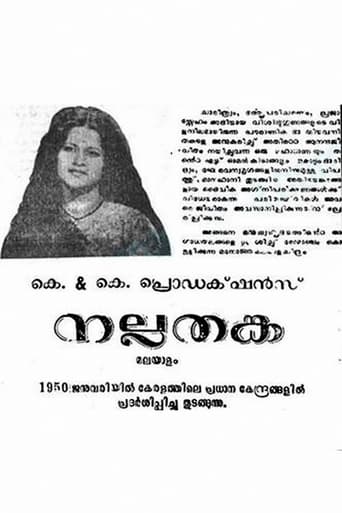
Nalla Thanka (1950)
നല്ലതങ്ക
Nalla Thanka , the only sister of Nallannan , the King of Madhurapuri, is wedded to Somanathan , the king of the neighbouring kingdom Ratnapuri. Alankari, the wicked wife of Nallannan becomes envious of the prosperity of Ratnapuri and the happy married life of Nalla Thanka.
- Date of release
- 1950-12-31
- TMDB
- 7.0 / 10 (1)
- Runtime
- 2h 45m
- Genres
- Drama
- Director
- P. V. Krishna Iyer
Casting
- Miss Kumari — Nalla Thanka
- Augustine Joseph — Nallannan
- Vaikom Mani — Somanathan
- T R Omana — Alankari
- S. P. Pillai
- Muthukulam Raghavan Pillai
Interesting facts
Nalla Thanka is a 1950 Indian Malayalam-language mythological film directed by P. V. Krishna Iyer and produced by K. V. Koshy and Kunchacko under the banner of Udaya Studios and K & K Combines. It was the second film produced at the Udaya Studios, the first being Vellinakshatram (1949). The film stars Miss Kumari in the title role along with Augustine Joseph, Vaikom Mani and Miss Omana in supporting roles. The film is based on the legend of Nalla Thanka, which is based on a popular Tamil folk tale.
Production
The success of Tamil operas based on the folk tale of Nalla Thanka in Kerala prompted Vaidyaratnam P. S. Varier to script a Malayalam drama based on the same story. He then authored the musical opera Nalla Thanka, for the drama troupe Kottakkal Paramasiva Vilasam. The drama became very popular in Kerala.
After the failure of their first feature film Vellinakshatram (1949), K. V. Koshy and Kunchacko were in deep debt. They decided to produce another feature film to recoup their losses. They decided to adopt the drama into a film as it was already popular and was a guaranteed success. Kunchacko mortgaged all his land and sold the family's jewellery to complete the film. The screenplay and dialogues were written by Muthukulam Raghavan Pillai.
Thresiamma (Miss Kumari) had earlier done a dance in Udaya's first film Vellinakshatram. Struck by her appearance and screen presence Kunchacko and Koshy cast her in the title role. She was rechristened Miss Kumari on the sets of the film. Augustine Joseph, the founder of the Udaya Kerala Natana Kala Samithi was asked to play the main lead.
Read on Wikipedia · Text from Wikipedia, CC BY-SA 4.0. Data from Wikidata.
Recommended
- Salomé 2013 · ★ 6.1
- Jungleland 2020 · ★ 6.4
- Fast Girls 2012 · ★ 6.0
- Girl in the Box 2016 · ★ 6.7
- Hands of Stone 2016 · ★ 6.6
- My Dinner with Hervé 2018 · ★ 6.3
- Bobby Jones: Stroke of Genius 2004 · ★ 5.9
- Lorelei 2020 · ★ 6.0
- I Am Elizabeth Smart 2017 · ★ 6.8
- The Pumpkin Eater 1964 · ★ 6.6
- Prizefighter: The Life of Jem Belcher 2022 · ★ 6.2
- Gigi & Nate 2022 · ★ 7.7