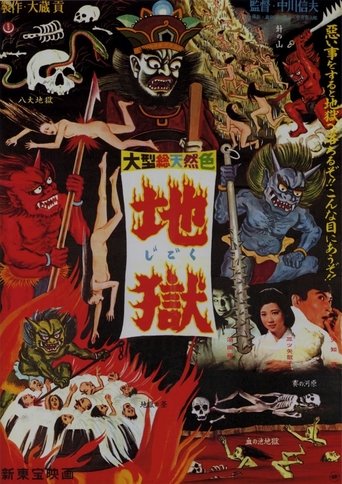
Jigoku - Das Tor zur Hölle (1960)
地獄
Der Theologiestudent Shirô ist als Beifahrer mit seinem Kommilitonen Tamura unterwegs, als dieser einen offensichtlich angetrunkenen Spaziergänger überfährt. Tamura und Shirô begehen Fahrerflucht, doch die Mutter des Opfers hat den Unfallhergang beobachtet. Weil Shirô Gewissensbisse plagen, fährt er mit seiner Freundin Yukiko, der Tochter seines Theologieprofessors, zur Polizei. Auf dem Weg dorthin verunglückt jedoch das Fahrzeug und Yukiko stirbt. Zu allem Überfluss erfährt Shirô auch noch, dass seine Mutter sterbenskrank ist, weshalb er zu ihr aufs Land fährt. Doch auch die Mutter und die Witwe des Unfallopfers sind auf dem Weg dorthin und das ansässige Altenheim scheint im wahrsten Sinne des Wortes ein Vorhof zur Hölle zu sein…
Besetzung
- Amachi Shigeru — Shirô Shimizu
- 三ツ矢歌子 — Yukiko / Sachiko
- 沼田曜一 — Tamura
- 林寛 — Gôzô Shimizu
- Kanjūrō Arashi — Enma
- 大友純 — Ensai Taniguchi
- 山下晶子 — Kinuko
- Kiyoko Tsuji — Kyôichi's Mother
- 宮田文子 — Mrs. Yajima
- 中村彰 — Professor Yajima
- 徳大寺君枝 — Ito Shimizu
- Akiko Ono — Yoko
Wissenswertes
Jigoku, also titled The Sinners of Hell, is a 1960 Japanese horror film directed by Nobuo Nakagawa and produced by Shintoho. The film stars Shigeru Amachi, Utako Mitsuya, and Yōichi Numata, and is notable for separating itself from other Japanese horror films of the era such as Kwaidan or Onibaba due to its graphic imagery of torment in Hell. It has gained a cult film status. Shintoho declared bankruptcy in 1961, its last production being Jigoku.
Production
Nobuo Nakagawa asked Ichirō Miyagawa to write the script, which was originally supposed to be called Heaven and Hell, under order of producer Mitsugu Okura. They had been influenced by various conversations they had about guilt and sins, with various inspirations ranging from the thought experiment Plank of Carneades to hearing a report about a fisherman selling poisoned fish he caught in a river to Faust.
The film was not expected to be well received, as Shintoho studio was considered to be a maker of low-budget, gory films. Jigoku was made in a hurry, and was the last Shintoho production. For the scenes which take place in hell, the cast and crew used Shintoho's largest soundstage and put dirt over it.
Auf Wikipedia weiterlesen · Text aus Wikipedia, CC BY-SA 4.0. Daten aus Wikidata.
Empfohlen
- Demoniac: Macht der Finsternis 2023 · ★ 6.7
- The Woman 2011 · ★ 6.1
- Hellbound: Hellraiser II 1988 · ★ 6.4
- In den Krallen des Hexenjägers 1971 · ★ 6.2
- They Reach - Manche Tore sollte man nie öffnen 2020 · ★ 6.8
- Exzesse im Folterkeller 1979 · ★ 6.2
- Caged 2021 · ★ 6.2
- The Surrender 2025 · ★ 5.9
- The Deliverance 2024 · ★ 6.0
- Vier im rasenden Sarg 1975 · ★ 6.4
- Devilman: Die Geburt 1987 · ★ 7.1
- Entity 1982 · ★ 6.8