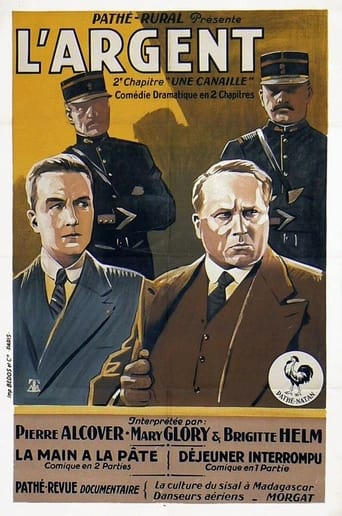
돈 (1928)
L'Argent
1920년대 파리의 금융가, 은행가 사카르는 숙적 군데르만 때문에 궁지에 몰린다. 사카르는 증자를 시도하고, 은행의 주가를 올리기 위해 인기 비행사 아믈랭을 끌어들여 남미에서의 석유 시추 사업을 추진한다. 군데르만은 사카르의 계획을 반대하지만, 훗날 무기로 쓸 요량으로 사카르의 주식을 몰래 사둔다. 한편, 아믈랭이 비행을 떠난 사이, 사카르는 그의 아내 린을 유혹하려 한다. 에밀 졸라가 쓴 동명소설을 각색하였으며, 정점에 이른 레르비에의 역량을 볼 수 있다. 웅장한 세트를 누비는 화려한 카메라워크는 지금 보아도 탄복하지 않을 수 없다. 디지털 복원판 상영. (2017 영화의 전당 - [시네마테크] 마지막 침묵: 1928년의 기적, 위대한 무성영화의 기억)
- 개봉일
- 1928-12-25
- TMDB
- 7.1 / 10 (45)
- 상영 시간(분)
- 2시간 45분
- 장르
- 드라마
- 감독
- Marcel L'Herbier
출연진
- Pierre Alcover — Nicolas Saccard
- Brigitte Helm — Baronin Sandorf
- Henry Victor — Jacques Hamelin
- Marie Glory — Line
- Alfred Abel — Alphonse Gunderman
- Antonin Artaud — Mazaud
- Jules Berry — Huret
- Yvette Guilbert — La Méchain
- Pierre Juvenet
- Raymond Rouleau
- Marcelle Pradot
- Roger Karl
흥미로운 사실
- 원작: 돈
L'Argent ("money") is a French silent film directed in 1928 by Marcel L'Herbier. The film was adapted from the 1891 novel L'Argent by Émile Zola, and it portrays the world of banking and the stock market in Paris in the 1920s.
Production
L'Herbier's decision to update Zola's story to the present-day met with strong criticism even before filming began. The theatre and film director André Antoine published a newspaper article denouncing such a betrayal of Zola's depiction of society in the Second Empire and arguing that it was unacceptable to treat a classic work of literature in this way.
Filming began in spring 1928 and continued until the autumn. At the Joinville Studios, art directors André Barsacq and Lazare Meerson constructed several monumental sets for key scenes: the grand interiors of the respective banks of Saccard and Gunderman, the Hamelins' apartment with its view over the skyline of Paris, the baroness Sandorf's mansion with its split-level gaming room, and for Saccard's party the massive room in his house with one w…
For his principal cameraman L'Herbier chose Jules Kruger who had devised the elaborate camerawork of Gance's Napoléon. Within the huge spaces of the sets they employed unusually active movements for the camera whose virtuosity makes them highly visible to the spectator. At Saccard's party the camera glides back and forth above the guests; in the bank scenes it moves alongside and among the crowds.
Another innovation that L'Herbier employed for the first screening of the film was the use of recorded sound effects. For the scenes of Hamelin's take-off at the airfield, which is intercut with scenes of frantic activity at the Bourse, authentic recordings were made in both settings and then a composite blend of them was played back from records in the cinema.
L'Herbier's original cut of the film, which was shown to the press in December 1928, ran for about 200 minutes. During the latter stages of production, his relationship with Jean Sapène, his co-producer, had virtually broken down, and to his dismay he found that at the first public showing in Paris in January 1929, the film had been re-edited in places on Sapène's instructions and was now more than 30 minutes shorter.
위키백과에서 더 읽기 · 텍스트 출처: 위키백과, CC BY-SA 4.0. 데이터 출처: Wikidata.
추천
- Chaos 2001 · ★ 6.4
- 살로메 2013 · ★ 6.1
- 스타비스키 1974 · ★ 5.9
- 보석 강도단 1968 · ★ 6.7
- Out of Love 2025 · ★ 6.9
- 패스트 걸스 2012 · ★ 6.0
- 핸즈 오브 스톤 2016 · ★ 6.6
- Love Me No More 2008 · ★ 7.1
- 살아가는 나날들 1984 · ★ 6.4
- 미국에서 가장 미움받는 여인 2017 · ★ 6.2
- 바비 존스: 스트로크 오브 지니어스 2004 · ★ 5.9
- 비올레타 2011 · ★ 6.5