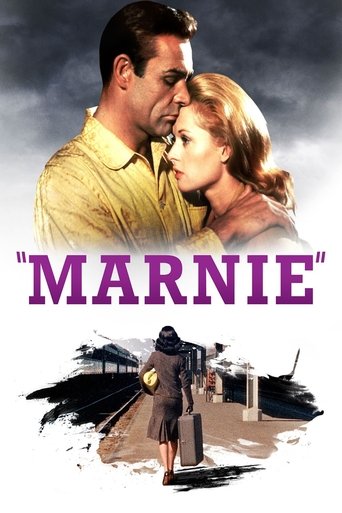
Marnie (1964)
The more he loved her . . . The more she hated him . . . For trying to unravel her secret!
Marnie is a beautiful but emotionally withdrawn thief, stealing from employers before disappearing under new identities. When her new boss, Mark Rutland, discovers her secret, his fascination turns to obsession, and he blackmails her into marriage, convinced he can cure her. But as he probes deeper into Marnie’s fractured mind, long-buried fears and compulsions begin to surface.
- Date of release
- 1964-07-17
- TMDB
- 7.1 / 10 (1280)
- Runtime
- 2h 10m
- Genres
- Thriller, Mystery, Romance
- Director
- Alfred Hitchcock
Casting
- Tippi Hedren — Marnie Edgar
- Sean Connery — Mark Rutland
- Diane Baker — Lil Mainwaring
- Martin Gabel — Sidney Strutt
- Louise Latham — Bernice Edgar
- Bob Sweeney — Cousin Bob
- Milton Selzer — Man at Track
- Mariette Hartley — Susan Clabon
- Alan Napier — Mr. Rutland
- Bruce Dern — Sailor
- Henry Beckman — First Detective
- S. John Launer — Sam Ward
Interesting facts
- Box office: $7M
- Budget: $3M
- Earned 2.3× its budget
- Based on: Marnie
Marnie is a 1964 American psychological thriller film directed by Alfred Hitchcock from a screenplay by Jay Presson Allen, based on the 1961 novel by Winston Graham. The film stars Tippi Hedren and Sean Connery.
Production
Alfred Hitchcock began developing the film adaptation of Winston Graham's novel Marnie in 1961. He commissioned Joseph Stefano, the screenwriter of Hitchcock's recently released Psycho, to work on the script. Stefano made extensive notes and wrote a 161-page treatment.
After completing The Birds, Hitchcock returned to the Winston Graham adaptation. Stefano dropped out of the project due to his commitments to the ABC television series The Outer Limits. Evan Hunter, who had written the screenplay for The Birds, developed Marnie with Hitchcock, and wrote several drafts. Hunter was unhappy with the rape scene in the original novel, as he felt the audience would lose sympathy for the male lead.
Hitch held up his hands the way directors do when they're framing a shot. Palms out, fingers together, thumbs extended and touching to form a perfect square. Moving his hands toward my face, like a camera coming in for a close shot, he said, "Evan, when he sticks it in her, I want that camera right on her face".
Hunter wrote a draft containing the rape scene but also wrote an additional, substitute sequence, which he pleaded with Hitchcock to use instead. Hunter was dismissed from the project on 1 May 1963. His replacement, Jay Presson Allen, later told him that "you just got bothered by the scene that was his reason for making the movie. You just wrote your ticket back to New York".
According to royal biographer Craig Brown, Hitchcock offered Princess Grace the title role in March 1962, and she accepted; but in Monaco, the reaction to the announcement was categorically negative. As he wrote: "Monegasques did not like the idea of their princess being filmed kissing another man. Little did they know that Hitchcock also had plans for him to rape her".
Read on Wikipedia · Text from Wikipedia, CC BY-SA 4.0. Data from Wikidata.
Recommended
- June and John 2025 · ★ 6.1
- Blow Out 1981 · ★ 7.3
- Don't Say a Word 2001 · ★ 6.3
- Awake 2007 · ★ 6.6
- X 2011 · ★ 6.4
- Wild at Heart 1990 · ★ 7.0
- Eastern Promises 2007 · ★ 7.3
- Gone 2012 · ★ 6.2
- Shattered 1991 · ★ 6.2
- Dead Again 1991 · ★ 6.4
- Stowaway 2022 · ★ 6.0
- Abduction 2011 · ★ 5.8