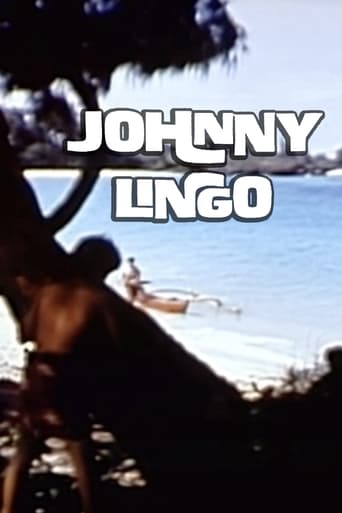
Johnny Lingo (1969)
Johnny Lingo bargains his dowry for a bride, paying an exorbitant dowry and causing a sensation on the island. Being an expert trader, he knows the value of things—especially self-esteem.
Johnny Lingo, one of the sharpest traders in the south pacific islands decides to bargain for a wife, and offers a record price of eight cows for Mahana, a plain girl who shuns contact. This causes quite a sensation on the island. A year later Johnny and his wife return for the first time since the marriage, and all find that something miraculous has occurred to Mahana. Johnny explains that by paying eight cows he proved that she was worth more to him than any other woman on the island. He gave her a great gift, that of self-worth.
- Date of release
- 1969-01-01
- TMDB
- 6.0 / 10 (7)
- Runtime
- 25m
- Genres
- Drama, Family
- Director
- Judge Whitaker
Casting
- MaKee K. Blaisdell — Johnny Lingo
- Naomi Kahoilua — Mahana
- Francis L. Urry — Mr. Harris
- Joseph R. TeNgaio — Moki’s Counselor
- Joseph W. Ah Quin — Moki
- Malofau Maumasi — Tulo
- Kent Fonoimoana
Interesting facts
Johnny Lingo is a 1969 short film directed by Wetzel O. Whitaker. The film and later remake are based on a short story by Patricia McGerr, originally published in a 1965 issue of Woman's Day. The 24-minute film was produced by Brigham Young University, but does not specifically mention The Church of Jesus Christ of Latter-day Saints outside of the credits.
Production
The film was based on the 1965 short story, "Johnny Lingo and the Eight-Cow Wife", written by author Patricia McGerr and published in Woman's Day magazine. The story has been frequently reprinted, including in The Australian Women's Weekly, The Instructor, and Reader's Digest, as well as by assorted books and websites (sometimes condensed or attributed to other authors).
Filmed in Hawaii in November 1968 and featuring mostly local LDS Church members, the film was directed by Wetzel O. ("Judge") Whitaker, then head of the Brigham Young University's Department of Motion Picture Production. Whitaker stated that "the setting is mythical to give it universal appeal" and the village set was constructed by two BYU (then Church College of Hawaii) students, Tuione Pulotu and Vuna Fa, to not be identifiable as belonging to…
Read on Wikipedia · Text from Wikipedia, CC BY-SA 4.0. Data from Wikidata.
Recommended
- The Legend of Johnny Lingo 2003 · ★ 7.2
- Whale Rider 2003 · ★ 7.0
- Cast Away 2000 · ★ 7.7
- Journey to Bethlehem 2023 · ★ 7.7
- Little Lord Fauntleroy 1980 · ★ 7.3
- Skater Girl 2021 · ★ 7.2
- Where the Red Fern Grows 2003 · ★ 6.6
- Where the Red Fern Grows 1974 · ★ 6.9
- Unsung Hero 2024 · ★ 7.1
- Little Man Tate 1991 · ★ 6.6
- The Good Witch's Gift 2010 · ★ 7.6
- Return to Nim's Island 2013 · ★ 6.5