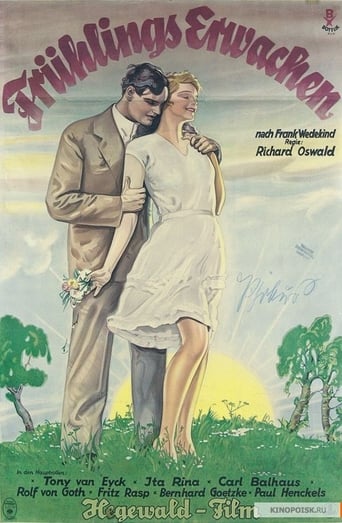
Spring Awakening (1929)
Frühlings Erwachen
Moritz Stiefel faces expulsion due to poor marks. When he is caught with an essay titled “Shame and Lust”, he is indeed kicked out – instead of classmate Melchior Gabor, who actually penned it. Gabor was drawing on his experiences with neighbourhood girl Wendla. Then Wendla turns up pregnant. Stiefel descends into despair ... Exploitation between Eros and Thanatos in this “sexual tragedy of youth” based on Frank Wedekind’s play. Setting the film in the 1920s provided a chance to explore “modern” youth culture, complete with cigarettes, jazz music, the gramophone, and a goodly bit of alcohol. Richard Oswald, a master of films of manners and young sex beginning in the 1910s, fully explores the temptations of the youthful body, even early childhood flirtatiousness. At the same time, with his target audience in mind, the film laments the bigotry and double standards of the adult world.
- Date of release
- 1929-01-01
- TMDB
- 10.0 / 10 (1)
- Runtime
- 1h 35m
- Genres
- Drama
- Director
- Richard Oswald
Casting
- Toni van Eyck — Wendla
- Ita Rina — Ilse
- Carl Ballhaus — Moritz
- Rolf von Goth — Melchior Gabor
- Paul Henckels — Stiefel
- Mathilde Sussin — Mrs. Bergmann
- Willy Clever — Fahrendorf
- Valy Arnheim
- Fritz Rasp
- Bernhard Goetzke
Interesting facts
- Based on: Spring Awakening
Spring Awakening is a 1929 German silent drama film directed by Richard Oswald and starring Mathilde Sussin, Toni van Eyck and Paul Henckels. It is an adaptation of the play of the same title by Frank Wedekind. It was shot at the Halensee Studios in Berlin.
Read on Wikipedia · Text from Wikipedia, CC BY-SA 4.0. Data from Wikidata.
Recommended
- The German Lesson 2019 · ★ 6.5
- Hardball 2001 · ★ 6.5
- The Effect of Gamma Rays on Man-in-the-Moon Marigolds 1972 · ★ 7.3
- Hounddog 2008 · ★ 6.5
- Skin 2009 · ★ 6.4
- The Carpetbaggers 1964 · ★ 6.0
- Come Sunday 2018 · ★ 5.8
- What Maisie Knew 2013 · ★ 7.1
- In the Aisles 2018 · ★ 6.9
- In a Land That No Longer Exists 2022 · ★ 6.3
- Eleanor the Great 2025 · ★ 6.8
- Inside I'm Dancing 2004 · ★ 7.4