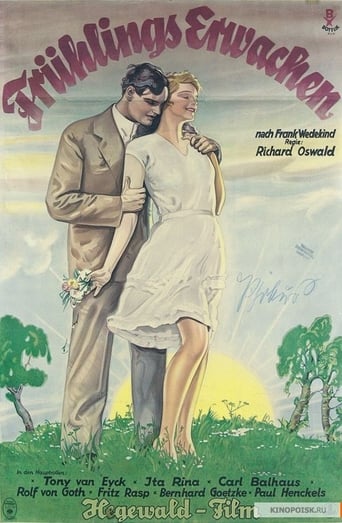
Frühlings Erwachen (1929)
Moritz Stiefel faces expulsion due to poor marks. When he is caught with an essay titled “Shame and Lust”, he is indeed kicked out – instead of classmate Melchior Gabor, who actually penned it. Gabor was drawing on his experiences with neighbourhood girl Wendla. Then Wendla turns up pregnant. Stiefel descends into despair ... Exploitation between Eros and Thanatos in this “sexual tragedy of youth” based on Frank Wedekind’s play. Setting the film in the 1920s provided a chance to explore “modern” youth culture, complete with cigarettes, jazz music, the gramophone, and a goodly bit of alcohol. Richard Oswald, a master of films of manners and young sex beginning in the 1910s, fully explores the temptations of the youthful body, even early childhood flirtatiousness. At the same time, with his target audience in mind, the film laments the bigotry and double standards of the adult world.
- 개봉일
- 1929-01-01
- TMDB
- 10.0 / 10 (1)
- 상영 시간(분)
- 1시간 35분
- 장르
- 드라마
- 감독
- Richard Oswald
출연진
- Toni van Eyck — Wendla
- Ita Rina — Ilse
- Carl Ballhaus — Moritz
- Rolf von Goth — Melchior Gabor
- Paul Henckels — Stiefel
- Mathilde Sussin — Mrs. Bergmann
- Willy Clever — Fahrendorf
- Valy Arnheim
- Fritz Rasp
- Bernhard Goetzke
흥미로운 사실
- 원작: 눈 뜨는 봄
Spring Awakening is a 1929 German silent drama film directed by Richard Oswald and starring Mathilde Sussin, Toni van Eyck and Paul Henckels. It is an adaptation of the play of the same title by Frank Wedekind. It was shot at the Halensee Studios in Berlin.
위키백과에서 더 읽기 · 텍스트 출처: 위키백과, CC BY-SA 4.0. 데이터 출처: Wikidata.
추천
- 더 저먼 레슨 2019 · ★ 6.5
- 인 디 아일 2018 · ★ 6.9
- 하드볼 2001 · ★ 6.5
- 감마선은 금잔화에 어떤 영향을 끼쳤나? 1972 · ★ 7.3
- The Carpetbaggers 1964 · ★ 6.0
- 하운드독 2008 · ★ 6.5
- Skin 2009 · ★ 6.3
- 그날이 오면 2018 · ★ 5.8
- Fog in August 2016 · ★ 7.4
- 메이지가 알고 있었던 일 2013 · ★ 7.1
- 인사이드 아임 댄싱 2004 · ★ 7.4
- 올 데이 앤 어 나이트 2020 · ★ 6.3