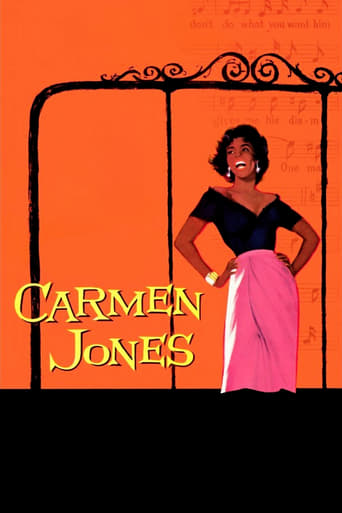
Carmen Jones (1954)
Something Really New! Something Truly Different!
In this musical set in an all-Black army camp, civilian parachute maker and "hot bundle" Carmen Jones is desired by many of the men. Naturally, she wants Joe, who's engaged to sweet Cindy Lou and about to go into pilot training for the Korean War.
- Date of release
- 1954-10-28
- TMDB
- 6.2 / 10 (104)
- Runtime
- 1h 45m
- Genres
- Drama, Romance
- Director
- Otto Preminger
Casting
- Harry Belafonte — Joe
- Dorothy Dandridge — Carmen Jones
- Pearl Bailey — Frankie
- Olga James — Cindy Lou
- Joe Adams — Husky Miller
- Brock Peters — Sergeant Brown
- Roy Glenn — Rum Daniels
- Nick Stewart — Dink Franklin
- Diahann Carroll — Myrt
- Le Vern Hutcherson — Joe (voice)
- Marilyn Horne — Carmen Jones (voice)
- Marvin Hayes — Husky Miller (voice)
Interesting facts
- Based on: Carmen Jones and Carmen
- Awards: 2 · Nominations: 5. Including: Golden Globe Award for New Star of the Year – Actor; Golden Globe Award for Best Motion Picture – Musical or Comedy
Carmen Jones is a 1954 American musical film featuring an African-American cast starring Harry Belafonte, Dorothy Dandridge, and Pearl Bailey and produced and directed by Otto Preminger. The screenplay by Harry Kleiner is based on the lyrics and book by Oscar Hammerstein II, from the 1943 stage musical of the same name, set to the music of Georges Bizet's 1875 opera Carmen. The opera was an adaptation of the 1845 Prosper Mérimée novella Carmen by Henri Meilhac and Ludovic Halévy.
Production
The Broadway production of Carmen Jones by Billy Rose opened on December 2, 1943, and ran for 503 performances. When he saw it, Otto Preminger dismissed it as a series of "skits loosely based on the opera", with a score "simplified and changed so that the performers who had no operatic training could sing it." In adapting it for the screen, he wanted to make "a dramatic film with music rather than a conventional film musical," so he decided to re…
Preminger realized no major studio would be interested in financing an operatic film with an all-African-American cast, so he decided to produce it independently. He anticipated United Artists executives Arthur B. Krim and Robert S. Benjamin, who had supported him in his censorship battles with The Moon Is Blue, would be willing to invest in the project, but the two felt it was not economically viable and declined.
On April 14, 1954, six weeks before principal photography was scheduled to begin, Preminger was contacted by Joseph Breen, who was in the final months of his leadership of the office of the Motion Picture Production Code. Breen had clashed with Preminger over The Moon Is Blue and still resented the director's success in releasing that film without a seal of approval.
Because he was sensitive to the issue of racial representation in the film, Preminger had no objections when Zanuck urged him to submit the script to Walter Francis White, executive secretary of the NAACP. White had no objection to it.
Preminger began to assemble his cast. Harry Belafonte, a folk singer who recently had introduced calypso music to a mainstream audience, had only one film to his credit. But he had just won the Tony Award and Theatre World Award for his performance in John Murray Anderson's Almanac, and Preminger cast him as Joe.
Read on Wikipedia · Text from Wikipedia, CC BY-SA 4.0. Data from Wikidata.
Recommended
- A Walk to Remember 2002 · ★ 7.7
- The Sleeping Dictionary 2003 · ★ 6.6
- Waterloo Bridge 1940 · ★ 7.5
- South Pacific 1958 · ★ 6.1
- Love Me Tender 1956 · ★ 6.3
- The Secret: Dare to Dream 2020 · ★ 7.4
- Magnificent Obsession 1954 · ★ 6.8
- Les Misérables 2012 · ★ 7.3
- The Wings of the Dove 1997 · ★ 6.5
- The Way We Were 1973 · ★ 7.0
- Gone with the Wind 1939 · ★ 7.9
- Casablanca 1943 · ★ 8.1