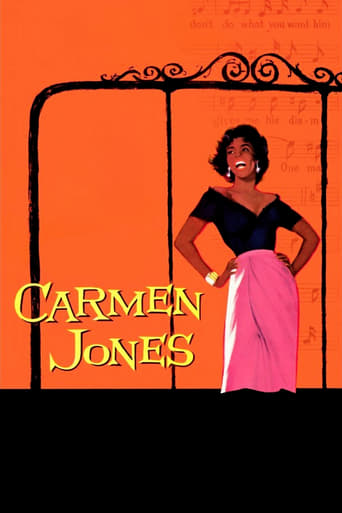
卡门·琼斯 (1954)
Carmen Jones
那个口衔金合欢的西班牙吉卜赛女郎,对人间的伦理规范视若无睹,认为爱情是无法束缚的鸟儿,即使情人夺走她的生命,却夺不走她那颗自由不羁的心。 卡门出自十九世纪法国小说家梅莱美笔下,她的倾城魅力举世闻名,洋溢着不自觉的女性解放思想,是西方最具神话色彩的女性角色之一。 乔伊甫获准进入飞行官校,青梅竹马女友辛蒂陆前往营区会面,并计划向指挥官申请结婚许可,却碰上卡门于后勤部门闹事,士官长故意派乔伊押送卡门到镇上法庭,乔伊只好留下辛蒂陆;沿途卡门百般勾引,忠厚的乔伊终为卡门的美色与慧点所惑,卡门趁机脱逃,乔伊受军法判入狱;日夜思念仍是卡门,一出狱未回校报到即先探访卡门,为保护卡门不受士官长调戏却打伤长官,被迫沦为逃兵与卡门流落芝加哥。卡门却以美艳让拳击冠军赫斯基米勒魂牵梦系,并以华屋美裘令卡门女友说服卡门投入其怀抱,卡门占卜得知乔伊将置其于死地,决心摆脱,希望于赫斯基庇护下可免于一死,乔伊不理辛蒂陆深情恳求,挟持卡门希望求得卡门之爱,却在卡门冷嘲热讽中……
- 上映日期
- 1954-10-28
- TMDB
- 6.2 / 10 (105)
- 片长(分钟)
- 1小时45分钟
- 类型
- 剧情, 爱情
- 导演
- 奥托·路德维希·普雷明格
演员阵容
- 哈利·贝拉方提 — Joe
- Dorothy Dandridge — Carmen Jones
- 珀尔·贝利 — Frankie
- Olga James — Cindy Lou
- Joe Adams — Husky Miller
- 布洛克·彼得斯 — Sergeant Brown
- Roy Glenn — Rum Daniels
- Nick Stewart — Dink Franklin
- 黛汉恩·卡罗尔 — Myrt
- Le Vern Hutcherson — Joe (voice)
- Marilyn Horne — Carmen Jones (voice)
- Marvin Hayes — Husky Miller (voice)
趣闻
- 改编自:胭脂虎新傳和卡門 (中篇小說)
- 获奖:2 · 提名:5. 包括:金球獎最佳男新人獎; 金球獎最佳音樂及喜劇電影
Carmen Jones is a 1954 American musical film featuring an African-American cast starring Harry Belafonte, Dorothy Dandridge, and Pearl Bailey and produced and directed by Otto Preminger. The screenplay by Harry Kleiner is based on the lyrics and book by Oscar Hammerstein II, from the 1943 stage musical of the same name, set to the music of Georges Bizet's 1875 opera Carmen. The opera was an adaptation of the 1845 Prosper Mérimée novella Carmen by Henri Meilhac and Ludovic Halévy.
Production
The Broadway production of Carmen Jones by Billy Rose opened on December 2, 1943, and ran for 503 performances. When he saw it, Otto Preminger dismissed it as a series of "skits loosely based on the opera", with a score "simplified and changed so that the performers who had no operatic training could sing it." In adapting it for the screen, he wanted to make "a dramatic film with music rather than a conventional film musical," so he decided to re…
Preminger realized no major studio would be interested in financing an operatic film with an all-African-American cast, so he decided to produce it independently. He anticipated United Artists executives Arthur B. Krim and Robert S. Benjamin, who had supported him in his censorship battles with The Moon Is Blue, would be willing to invest in the project, but the two felt it was not economically viable and declined.
On April 14, 1954, six weeks before principal photography was scheduled to begin, Preminger was contacted by Joseph Breen, who was in the final months of his leadership of the office of the Motion Picture Production Code. Breen had clashed with Preminger over The Moon Is Blue and still resented the director's success in releasing that film without a seal of approval.
Because he was sensitive to the issue of racial representation in the film, Preminger had no objections when Zanuck urged him to submit the script to Walter Francis White, executive secretary of the NAACP. White had no objection to it.
Preminger began to assemble his cast. Harry Belafonte, a folk singer who recently had introduced calypso music to a mainstream audience, had only one film to his credit. But he had just won the Tony Award and Theatre World Award for his performance in John Murray Anderson's Almanac, and Preminger cast him as Joe.
在维基百科阅读更多 · 文本来自维基百科,CC BY-SA 4.0。数据来自 Wikidata。