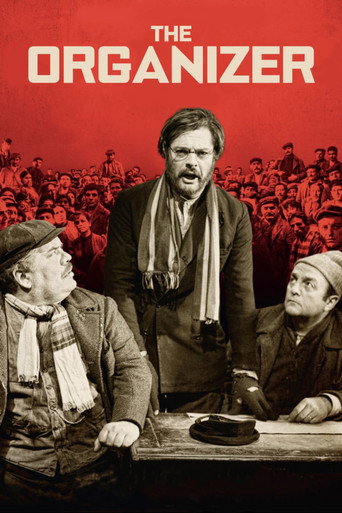
The Organizer (1963)
I compagni
A RARE MOTION PICTURE... BRILLIANT PERFORMANCE!
In the late 19th century, a former high school teacher turned unionist tries to organize workers laboring with inhuman conditions at a textile factory in Turin, Italy.
- Date of release
- 1963-10-25
- TMDB
- 7.5 / 10 (138)
- Runtime
- 2h 10m
- Genres
- Drama, Crime, Comedy
- Director
- Mario Monicelli
Casting
- Marcello Mastroianni — Professor Sinigaglia
- Renato Salvatori — Raoul
- Gabriella Giorgelli — Adele
- Folco Lulli — Pautasso
- Bernard Blier — Martinetti
- Raffaella Carrà — Bianca
- François Périer — Maestro Di Meo
- Vittorio Sanipoli — Baudet
- Mario Pisu — Manager
- Kenneth Kove — Luigi
- Annie Girardot — Niobe
- Edda Ferronao — Maria
Interesting facts
- Awards: 2 · Nominations: 1. Including: Nastro d'Argento for Best Supporting Actor; Astor d'Oro for best film
The Organizer is a 1963 Italian-French-Yugoslavian-produced drama film written by Mario Monicelli and Age & Scarpelli, and directed by Mario Monicelli. Set in Turin at the end of the 19th century, it stars Marcello Mastroianni as a labor activist who becomes involved with a group of textile factory workers who go on strike.
Background
Italy’s first capital after the Risorgimento ended in the 1870s, Turin was in the midst of rapid industrialization during the period of The Organizer, although the film unfolds some years before the growth of the industry. Populating his densely inhabited film with actual workers, Monicelli was attempting, three years before The Battle of Algiers (1966), to create a sort of neorealist period piece; using a strategy that would subsequently be seen…
Inspired, according to its director, by the revolutionary ghosts of Paris’s no longer extant Bastille and set in the slums of late-nineteenth-century Turin, the film accepts what the influential Italian Marxist leader Antonio Gramsci saw as “the challenge of modernity,” namely, “to live without illusions and without becoming disillusioned.” To that end, The Organizer is variously (and, for some, disconcertingly) jaunty, sentimental, comic, and ba…
known for its period detail and Giuseppe Rotunno’s faux-daguerreotype cinematography, the film is not so much a call to action as to recollection—both a historical monument and a depiction of a specific moment. Throughout, Rotunno’s black-and-white cinematography makes use of flat lighting and gray skies to emphasize soot and smoke.
Read on Wikipedia · Text from Wikipedia, CC BY-SA 4.0. Data from Wikidata.
Recommended
- Mafioso 1962 · ★ 7.6
- Nostalgia 2022 · ★ 6.8
- The Day of the Owl 1968 · ★ 7.1
- Riot in Cell Block 11 1954 · ★ 7.1
- The Big Fake 2025 · ★ 6.6
- 180 2026 · ★ 5.9
- Five Minutes of Heaven 2009 · ★ 6.1
- House of Strangers 1949 · ★ 7.0
- The Italian Job 1969 · ★ 6.9
- Billy Elliot 2000 · ★ 7.6
- Real Women Have Curves 2002 · ★ 6.1
- Piranhas 2019 · ★ 6.8