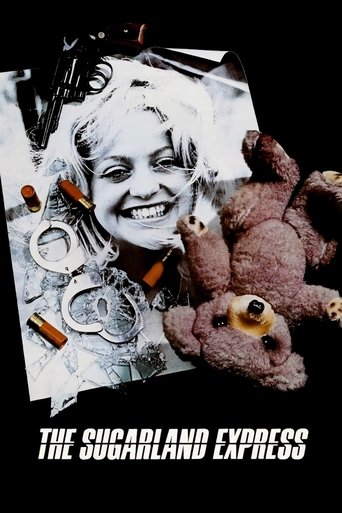
The Sugarland Express (1974)
A girl with a great following. Every cop in the state was after her. Everybody else was behind her.
Married small-time crooks Lou-Jean and Clovis Poplin lose their baby to the state of Texas and resolve to do whatever it takes to get him back. Lou-Jean gets Clovis out of jail, and the two steal their son from his foster home, in addition to taking a highway patrolman hostage. As a massive dragnet starts to pursue them across Texas, the couple become unlikely folk heroes and even start to bond with the captive policeman.
- Date of release
- 1974-03-31
- TMDB
- 6.6 / 10 (495)
- Runtime
- 1h 50m
- Genres
- Crime, Drama
- Director
- Steven Spielberg
Casting
- Goldie Hawn — Lou Jean Poplin
- William Atherton — Clovis Poplin
- Ben Johnson — Captain Tanner
- Michael Sacks — Slide
- Gregory Walcott — Mashburn
- Steve Kanaly — Jessup
- Louise Latham — Mrs. Looby
- Harrison Zanuck — Baby Langston
- A.L. Camp — Mr. Nocker
- Jessie Lee Fulton — Mrs. Nocker
- Dean Smith — Russ Berry
- Ted Grossman — Dietz
Interesting facts
- Box office: $12M
- Budget: $3M
- Earned 4× its budget
The Sugarland Express is a 1974 American crime drama film directed by Steven Spielberg. The film follows a woman and her husband as they take a police officer hostage and flee across Texas while they try to get to their child before he is placed in foster care. The film was based on true events, some of which occurred in Sugar Land, Texas, where parts of the film were shot. Other scenes were filmed in San Antonio, Live Oak, Floresville, Pleasanton, Converse and Del Rio, Texas.
Production
After working as a television director, Steven Spielberg made his first stand alone feature film-length production with the TV movie Duel, released in November 1971. After that he persuaded co-producers Richard Zanuck and David Brown to let him make his big-screen directorial debut with The Sugarland Express, which was based on a true story. Principal photography had been completed in 1973.
Clips from the Wile E. Coyote/Road Runner cartoon Whoa, Be-Gone! are shown in silence during a scene near a drive-in theater. Wile E. Coyote and the Road Runner later appeared in the 1988 Touchstone/Amblin film Who Framed Roger Rabbit.
This was the first movie to use the Panavision Panaflex camera.
Read on Wikipedia · Text from Wikipedia, CC BY-SA 4.0. Data from Wikidata.
Recommended
- Midnight Special 2016 · ★ 6.3
- A Perfect World 1993 · ★ 7.5
- John Q 2002 · ★ 7.2
- News of the World 2020 · ★ 6.9
- Palmetto 1998 · ★ 6.0
- Frontera 2014 · ★ 6.5
- Sleepwalking 2008 · ★ 6.1
- Extortion 2017 · ★ 6.1
- Cry Macho 2021 · ★ 5.9
- Kansas City 1996 · ★ 6.1
- Mad City 1997 · ★ 6.2
- The Parts You Lose 2019 · ★ 6.6