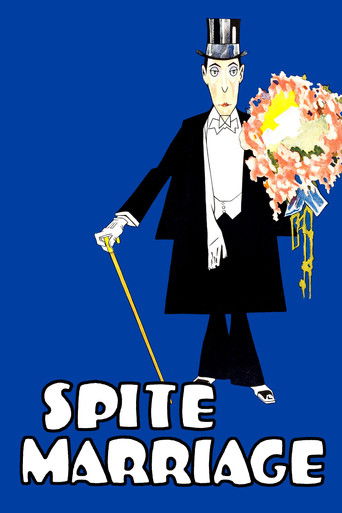
Spite Marriage (1929)
The Scream of the Screen-Buster in a Matrimonial Maelstrom – Buster's Adventure in Married Bliss.
An unimpressive but well-intentioned man is given the chance to marry a popular actress, of whom he has been a hopeless fan. But what he doesn't realize is that he is being used to make the actress' old flame jealous.
- Date of release
- 1929-03-24
- TMDB
- 6.6 / 10 (68)
- Runtime
- 1h 16m
- Genres
- Comedy
- Director
- Edward Sedgwick, Buster Keaton
Casting
- Buster Keaton — Elmer
- Dorothy Sebastian — Trilby Drew
- Edward Earle — Lionel Benmore
- Leila Hyams — Ethyl Norcrosse
- William Bechtel — Nussbaum
- Jack Byron — Scarzi
- Joe Bordeaux — Rumrunner
- Ray Cooke — The Bellboy
- Mike Donlin — Man in Ship's Engine Room
- Pat Harmon — Ship Captain
- Sydney Jarvis — Man in Audience Next to Elmer
- Theodore Lorch — Actor as 'Union Officer'
Interesting facts
Spite Marriage is a 1929 American silent comedy film co-directed by Buster Keaton and Edward Sedgwick and starring Keaton and Dorothy Sebastian. It is the second film Keaton made for MGM and his last silent film, although he had wanted it to be a "talkie" or full sound film. While the production has no recorded dialogue, it does feature an accompanying synchronized score and recorded laughter, applause, and other sound effects. Keaton later wrote gags for some up-and-coming MGM stars like Red Skelton, and recycled many gags from Spite Marriage, some shot-for-shot, for Skelton's 1943 film I Dood It.
Production and reception
According to the American Film Institute's catalog, production work on the film started on November 14, 1928, a date generally consistent with a November 27 report in Exhibitors Herald and Motion Picture World, which announces that Keaton began work on the film "last week."
News updates about the film in 1928 trade publications indicate that casting was still being finalized in the latter half of November. Exhibitors Daily Review announced on November 16: "Dorothy Sebastian has been given the feminine lead opposite Buster Keaton," and on November 23, "Edward Earle is playing the heavy in Buster Keaton's picture, Spite Marriage." A week later, The Distributor, a paper published by MGM's sales department, confirmed th…
Spite Marriage was released in April 1929, in two editions: a mute print for silent-only theaters, and a "synchronized" version for sound theaters, with the action accompanied by an orchestra score and sound effects. The feature was generally very well received by critics in leading newspapers, by reviewers in the film industry's major trade journals and papers, as well as by moviegoers.
The trade paper The Film Daily rated the MGM feature as "the funniest film released in months." In its March 31 review, the paper praised the film and drew special attention to Sebastian's performance:Buster Keaton puts over one of the best he has ever done and has 'em fairly rocking in their seats.
Keaton subsequently appeared in MGM's all-talking variety show The Hollywood Revue of 1929 but his performance was entirely in pantomime. Audiences attending M-G-M's theaters had to wait until the spring of 1930 to hear Keaton's voice, in the musical comedy Free and Easy.
Read on Wikipedia · Text from Wikipedia, CC BY-SA 4.0. Data from Wikidata.
Recommended
- Duplex 2003 · ★ 6.1
- Fun with Dick and Jane 1977 · ★ 6.6
- Rowan Atkinson Live 1992 · ★ 8.2
- Gabriel Iglesias: Hot and Fluffy 2007 · ★ 7.6
- Monkey Business 1952 · ★ 6.7
- Zapped 2014 · ★ 6.1
- The Distinguished Gentleman 1992 · ★ 6.0
- Eurovision Song Contest: The Story of Fire Saga 2020 · ★ 6.4
- The Girl Can't Help It 1956 · ★ 6.3
- Gabriel Iglesias: Aloha Fluffy 2013 · ★ 7.1
- Brain Donors 1992 · ★ 6.1
- Thunderstruck 2012 · ★ 6.2