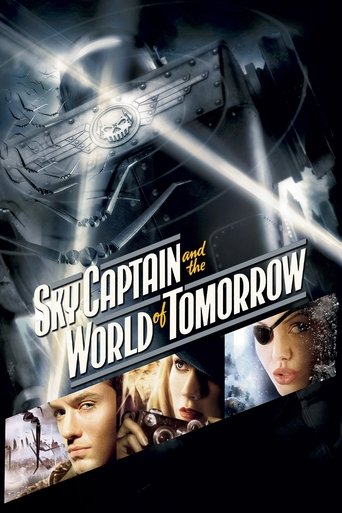
Sky Captain and the World of Tomorrow (2004)
Who will save us?
When gigantic robots attack New York City, "Sky Captain" uses his private air force to fight them off. His ex-girlfriend, reporter Polly Perkins, has been investigating the recent disappearance of prominent scientists. Suspecting a link between the global robot attacks and missing men, Sky Captain and Polly decide to work together. They fly to the Himalayas in pursuit of the mysterious Dr. Totenkopf, the mastermind behind the robots.
- Date of release
- 2004-09-17
- TMDB
- 5.9 / 10 (1453)
- Runtime
- 1h 47m
- Genres
- Science Fiction, Adventure
- Director
- Kerry Conran
Casting
- Jude Law — Sky Captain
- Gwyneth Paltrow — Polly Perkins
- Angelina Jolie — Franky
- Giovanni Ribisi — Dex
- Michael Gambon — Paley
- Bai Ling — Mysterious Woman
- Omid Djalili — Kaji
- Laurence Olivier — Dr. Totenkopf (archive footage)
- Trevor Baxter — Dr Walter Jennings
- Julian Curry — Dr. Vargas
- Peter Law — Dr. Kessler
- Jon Rumney — German Scientist
Interesting facts
- Box office: $58M
- Budget: $70M
- Earned 0.8× its budget
Sky Captain and the World of Tomorrow is a 2004 science fiction action-adventure film written and directed by Kerry Conran in his directorial debut, and produced by Jon Avnet, Sadie Frost, Jude Law and Marsha Oglesby. It stars Law, Gwyneth Paltrow, and Angelina Jolie.
Production
Kerry Conran grew up on films and comic books of the 1930s and 1940s. His parents encouraged him and his brother Kevin to develop their creative sides. He studied at a feeder program for Disney animators at CalArts and became interested in 2-D computer animation. While there, he realized it was possible to apply some of the techniques associated with animation to live-action.
Conran was influenced by the designs of Norman Bel Geddes, an industrial designer who did work for the 1933 Chicago World's Fair and designed exhibits for the 1939 New York World's Fair. Geddes also designed an Airliner Number 4 that was to fly from Chicago to London.
Another key influence was Hugh Ferriss, one of the designers for the 1939 New York World's Fair who designed bridges and huge housing complexes. He was an American delineator (one who creates perspective drawings of buildings) and architect. In 1922, skyscraper architect Harvey Wiley Corbett commissioned to draw a series of four step-by-step perspectives demonstrating the architectural consequences of the 1916 Zoning Resolution.
Regarding the 1939 New York World's Fair itself and its futuristic theme of the World of Tomorrow, Conran noted: "... obviously the title refers to the World Expo and the spirit of that was looking at the future with a sense of optimism and a sense of the whimsical, you know, something that we've lost a lot in our fantasies. We're more cynical, more practical, ...
Conran acknowledged his debt to German Expressionism, which was particularly evident in the opening scenes in New York City: "Early German cinema was born of just a completely different aesthetic than what we see nowadays. One of the last things I watched before starting this project was the Dr. Mabuse series that Lang had done—terribly inspirational, the use of art and propaganda even."
Read on Wikipedia · Text from Wikipedia, CC BY-SA 4.0. Data from Wikidata.
Recommended
- The Creator 2023 · ★ 7.0
- A-X-L 2018 · ★ 6.4
- Terminator Genisys 2015 · ★ 6.0
- I Am Mother 2019 · ★ 6.7
- Automata 2014 · ★ 5.9
- Pacific Rim 2013 · ★ 7.0
- Transformers: The Last Knight 2017 · ★ 6.1
- You Only Live Twice 1967 · ★ 6.6
- The Electric State 2025 · ★ 6.5
- Transformers: Dark of the Moon 2011 · ★ 6.2
- Surrogates 2009 · ★ 6.2
- Transformers: Age of Extinction 2014 · ★ 6.0