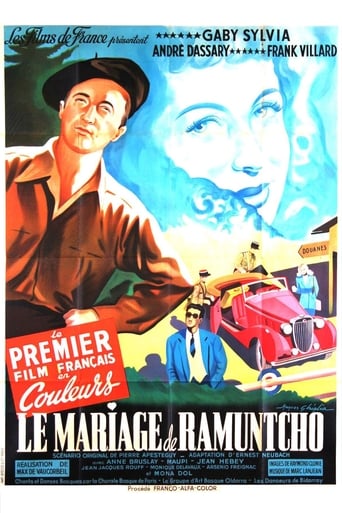
The Marriage of Ramuntcho (1947)
Le Mariage de Ramuntcho
A Parisian painter working in the Basque country succeeds in keeping together a young woman and her smuggler boyfriend, even though the artist has feelings for the intended bride himself, and then he completes a painting on the subject of the wedding.
- Date of release
- 1947-10-22
- TMDB
- 5.4 / 10 (5)
- Runtime
- 1h 18m
- Genres
- Comedy, Romance
- Director
- Max de Vaucorbeil
Casting
- Gaby Sylvia — Maritchu
- André Dassary — Ramuntcho
- Frank Villard — Georges
- Jean Hébey
- Marcel Maupi
- Anne-Marie Bruslay
- Jean-Jacques Rouff
- Monique Delavaud
- Arsenio Freignac
- Gustave Lacoste
- Lucien Callamand
- Jacques Lemoine
Interesting facts
The Marriage of Ramuntcho is a 1947 French comedy film directed by Max de Vaucorbeil and starring Gaby Sylvia, André Dassary and Frank Villard. It is often considered to be the first French feature using modern color photography. It is based on Pierre Loti's 1897 novel Ramuntcho.
Production
In early 1946, Alice Charles, manager of Films de France, a documentary and news specialist, announced that she was moving her offices to the headquarters of distributor Distribution Parisienne de Film (D.P.F.), as her company was looking to branch out into features with the support of new D.P.F. boss Henry de Saint-Girons. The Marriage of Ramuntcho was the first of a two-picture slate announced in mid-April 1946 by Films de France.
Both movies were hurried into production to capitalize on the discovery of unused Agfacolor reels left by the Germans at Éclair following their defeat. Producer Paul Dutournier chose to film Pierre Loti's novel Ramuntcho, largely from practical reasons: the story was set in his home region of the Basque Country, and he had already participated in another adaptation of the same novel before the war.
A color photography specialist named Hongrand was brought in from Belgium to assist the French crew, which had no experience with the medium, and a test session was organized between late April and early May in Sare, a location of the previous Ramuntcho adaptation. Films de France was also out of its depth on the administrative side.
Principal photography started in mid-July 1946. Various Basque performance groups, such as a dance troupe from Bidarray, were featured in the film. Supposedly, Dutournier enlisted the assistance of real smugglers working the Franco-Spanish border. Exterior filming in the Basque Country was marred by bad weather. Moreover, a significant part of the available stock had degraded significantly, barely leaving enough to complete the feature.
Much of the film, however, was shot at the Victorine Studios in Nice, where the expensive recreation of a Basque public square pushed it further into the red. On August 1, Alice Charles and Henry de Saint-Girons jointly resigned from their respective positions at the head of Films de France and D.P.F.
Read on Wikipedia · Text from Wikipedia, CC BY-SA 4.0. Data from Wikidata.
Recommended
- What's Love Got to Do with It? 2023 · ★ 6.1
- The Right Kind of Wrong 2013 · ★ 5.9
- After You 2003 · ★ 6.1
- Easy Virtue 2008 · ★ 6.5
- Yoh! Bestie 2026 · ★ 6.2
- ¿Quieres ser mi hijo? 2023 · ★ 8.4
- Girl on a Bicycle 2013 · ★ 5.9
- Maria into Life 2022 · ★ 6.0
- Sex Appeal 2022 · ★ 6.6
- Cuban Fury 2014 · ★ 6.1
- Gregoire Moulin vs. Humanity 2001 · ★ 6.8
- Love Is in the Air 2013 · ★ 6.0