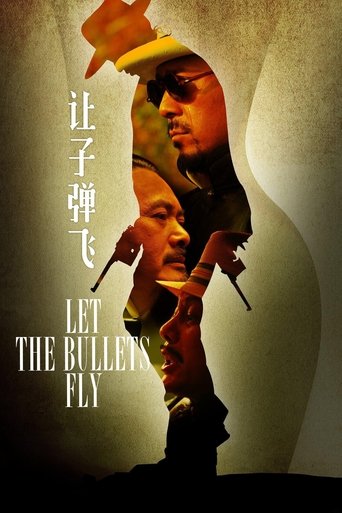
Furia gloanțelor (2010)
让子弹飞
When circumstances force an outlaw to impersonate a county governor and clean up a corrupt town, the Robin Hood figure finds himself in a showdown with the local godfather.
- Data lansării
- 2010-12-20
- TMDB
- 7.8 / 10 (371)
- Durată
- 2 h 12 min
- Genuri
- Acțiune, Comedie
- Regizor
- Jiang Wen
- Colecție
- 民国三部曲(系列)
Distribuție
- Jiang Wen — Pocky Zhang
- 周潤發 — Huang Silang
- 葛优 — Old Tang
- 劉嘉玲 — Magistrate's wife
- 邵兵 — The Second
- 廖凡 — The Third
- 杜奕衡 — The Four
- Jing Li — The Five
- Zhang Mo — The Six
- 危笑 — The Seven
- 周韵 — Sister Hua
- 陈坤 — Huwan
Curiozități
- Buget: 18 mil. USD
- Filmat în: Beijing
Let the Bullets Fly is a 2010 action comedy film written and directed by Jiang Wen, based on a story by Ma Shitu. The film is a Chinese-Hong Kong co-production, set in Sichuan during the 1920s when the bandit Zhang descends upon a town posing as its new governor. The film also stars Chow Yun-fat, Ge You, Carina Lau, and Chen Kun.
Production
Director Jiang Wen went over 30 drafts of the film's script. Jiang Wen and his writing team aimed to adapt the political satire of Ma Shitu’s (马识途) original short story, Ten Extraordinary Chinese Stories (夜谭十记), into an action-oriented narrative.
Filming took place primarily in Guangdong province, utilizing the Kaiping Diaolou (开平碉楼) in Zili Village (自力村) and Magang (马冈). These UNESCO World Heritage sites, characterized by fortified towers that blend Western and Chinese architectural elements, provided the setting for the fictional Goose Town (鹅城). The use of these historical structures grounded the production in an authentic setting, avoiding reliance on studio-built sets.
Joe Hisaishi composed the film's score. Jiang Wen requested the repurposing of orchestral themes from their previous collaboration, The Sun Also Rises (2007), to maintain thematic consistency across his "Beiyang Trilogy." The soundtrack employs brass-heavy arrangements to reinforce the film's masculine aesthetic and historical scale.
The film used the dark tones and the arrangement of yellow lighting to make the entire film more nostalgic and have a stronger sense of The Times. Its visual presentation also relies on rapid editing, frequent close-ups, compressed background space, and controlled camera movement to create a strong visual rhythm and heighten narrative tension.
The film's violent aesthetic is in line with the war background of the film in the 1920s, enhancing the film's entertainment value. Its stylized violence also reflects the film's use of western and spaghetti western genre conventions, including firearms, bandit figures, lawless local settings, and graphic violence.
Citește pe Wikipedia · Text din Wikipedia, CC BY-SA 4.0. Date din Wikidata.
Recomandate
- Copiii de la Templul Shaolin 1984 · ★ 6.2
- Breaking and Re-entering 2024 · ★ 6.0
- Wrong Cops 2013 · ★ 6.1
- Dennis, pericol public 1993 · ★ 5.9
- Fun with Dick and Jane 1977 · ★ 6.6
- Martial Arts of Shaolin 1986 · ★ 6.3
- Johnny English lovește din nou 2018 · ★ 6.3
- Hooper 1978 · ★ 6.3
- Firestorm 2013 · ★ 6.1
- Se-ncinge treaba! 2019 · ★ 6.6
- Dick Tracy 1990 · ★ 6.2
- The Apple Dumpling Gang Rides Again 1979 · ★ 6.4