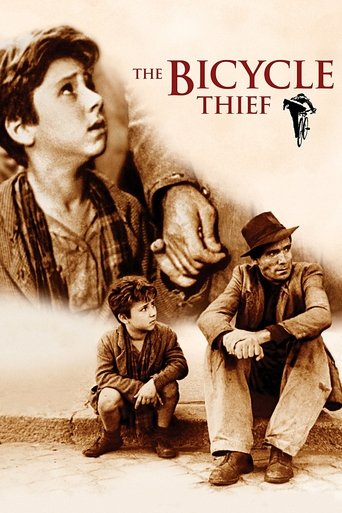
Bicycle Thieves (1948)
Ladri di biciclette
The Prize Picture They Want to Censor!
Unemployed Antonio is elated when he finally finds work hanging posters around war-torn Rome. However on his first day, his bicycle—essential to his work—gets stolen. His job is doomed unless he can find the thief. With the help of his son, Antonio combs the city, becoming desperate for justice.
- Date of release
- 1948-07-21
- TMDB
- 8.2 / 10 (2813)
- Runtime
- 1h 29m
- Genres
- Drama
- Director
- Vittorio De Sica
Casting
- Lamberto Maggiorani — Antonio
- Enzo Staiola — Bruno
- Lianella Carell — Maria
- Gino Saltamerenda — Baiocco
- Vittorio Antonucci — Alfredo Catelli, The Thief
- Giulio Chiari — The Beggar
- Elena Altieri — The Charitable Lady
- Carlo Jachino — A Beggar
- Michele Sakara — Secretary of the Charity Organization
- Emma Druetti
- Eolo Capritti — Carabiniere (uncredited)
- Fausto Guerzoni — Amateur Actor (uncredited)
Interesting facts
- Budget: $133K
- Awards: 3 · Nominations: 3. Including: National Board of Review: Top Ten Films; National Board of Review Award for Best Film; Academy Honorary Award
Bicycle Thieves, also known as The Bicycle Thief, is a 1948 Italian neorealist drama film directed by Vittorio De Sica. It follows the story of a poor father searching in post–World War II Rome for his stolen bicycle, without which he will lose the job which was to be the salvation of his young family.
Production
Bicycle Thieves is the best-known work of Italian neorealism, a movement that informally began with Roberto Rossellini's Rome, Open City (1945) and brought a new degree of realism to Italian cinema. De Sica had just made Shoeshine (1946), but was unable to get financial backing from any major studio for the film, so he raised the money himself from friends.
Staiola was almost run over on two occasions while crossing the street. De Sica chose to keep both incidents in the finished film.
The film's final shot of Antonio and Bruno walking away from the camera into the distance is an homage to many of the films of Charlie Chaplin, who was De Sica's favourite filmmaker.
Uncovering the drama in everyday life, the wonderful in the daily news.
Read on Wikipedia · Text from Wikipedia, CC BY-SA 4.0. Data from Wikidata.
Recommended
- Umberto D. 1952 · ★ 7.9
- The Children's Train 2024 · ★ 7.4
- Rome, Open City 1945 · ★ 8.0
- Europa '51 1952 · ★ 7.3
- Obsession 1976 · ★ 6.7
- Adopt a Highway 2019 · ★ 6.9
- Euphoria 2018 · ★ 6.5
- Five Seconds 2025 · ★ 6.7
- The Terrace 1980 · ★ 7.2
- On My Skin 2018 · ★ 8.0
- La Terra Trema 1949 · ★ 7.8
- The Spiral 2026 · ★ 7.5