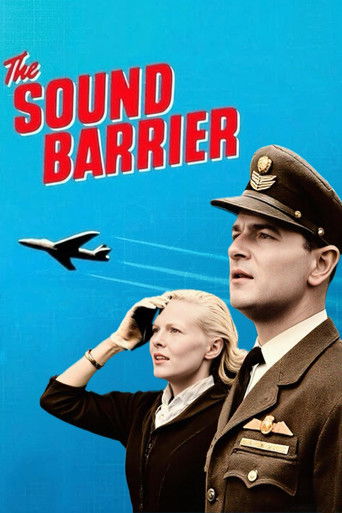
一飞冲天 (1952)
The Sound Barrier
托尼是一位成功的二战战斗机飞行员,娶了一个富有的石油大亨家族的女儿,这个大亨同时也设计飞机。电影追踪了公司试图突破音障的过程,以及父女之间的紧张关系。还有大量拍摄于20世纪50年代初英国的喷气式航空飞行画面,以及世界上第一架喷气式客机康宁客机的镜头。
演员阵容
- 拉尔夫·理查森 — John Ridgefield
- Ann Todd — Susan Garthwaite
- Nigel Patrick — Tony Garthwaite
- John Justin — Philip Peel
- Dinah Sheridan — Jess Peel
- Joseph Tomelty — Will
- 丹霍姆·艾略特 — Christopher Ridgefield
- Jack Allen — 'Windy'
- Ralph Michael — Fletcher
- 莱斯利·菲利普斯 — Controller
- Donald Harron — ATA officer
- Vincent Holman — Factor
趣闻
- 获奖:1 · 提名:2. 包括:奧斯卡最佳混音獎
The Sound Barrier is a 1952 British aviation drama film directed by David Lean. It is a fictional story about attempts by aircraft designers and test pilots to break the sound barrier. It was David Lean's third and final film with his wife Ann Todd but it was his first for Alexander Korda's London Films, following the break-up of Cineguild. The Sound Barrier stars Ralph Richardson, Ann Todd, John Justin and Nigel Patrick. It was known in the United States as Breaking Through the Sound Barrier and Breaking the Sound Barrier.
Production
The strong relationship to aviation history in The Sound Barrier has led to its being characterised as a "semi-documentary". The film pays tribute to the British effort in the historic advance in aviation of the development and final perfecting of the jet engine by Frank Whittle and Power Jets Ltd and others following.
David Lean had begun to gather research based on media reports of jet aircraft approaching supersonic speeds, interviewing British aeronautic designers. He even managed to fly with test pilots as he produced a 300-page notebook that he turned over to dramatist Terence Rattigan.
Kenneth More tested for the role of Tony. He says the part was offered to David Niven, with whom More was making Appointment with Venus but Niven turned it down. The role went to Nigel Patrick, who was more strongly established than More.
John Derry, another de Havilland test pilot, has been called "Britain's first supersonic pilot", because of a dive he made on 6 September 1948 in a DH 108. Contrary to what is depicted in the film, the first aircraft to break the sound barrier was the rocket-powered Bell X-1 flown by Chuck Yeager of the United States Air Force in 1947. His feat was portrayed in the 1983 film The Right Stuff.
Studio filming was completed at Shepperton Studios, but the flying sequences were filmed at Chilbolton Aerodrome, Nether Wallop, Hampshire, under the direction of Anthony Squire. A Vickers Valetta and Avro Lancaster bomber served as camera platforms for the aerial sequences.
在维基百科阅读更多 · 文本来自维基百科,CC BY-SA 4.0。数据来自 Wikidata。