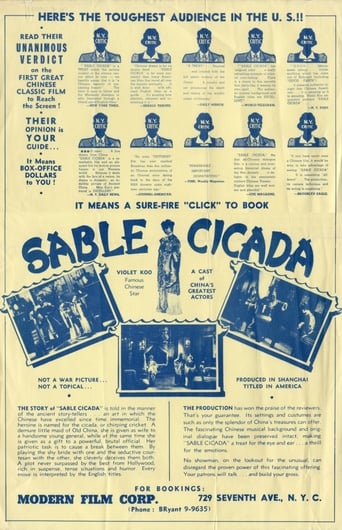
Sable Cicada (1938)
貂蟬
Diaochan (aka Diau Charn and Sable Cicada), one of the Four Beauties of China, is supposed to be so stunningly lovely that the moon was shamed to hide behind clouds. Despite being the only Beauty among the four who is not a real historical figure but one conjured by storytelling imagination and embellished by public fascination, her story was nonetheless incorporated by author Luo Guangzhong into his popular and influential novel Romance of the Three Kingdoms. Her tale is one of Machiavellian intrigue, in which she schemes with her godfather Wang Yun to restore moral order to the land, sowing discord between the corrupt Minister Dong Zhuo and his adopted son Lu Bu, a man of martial and military prowess.
- Date of release
- 1938-06-15
- TMDB
- 6.0 / 10 (1)
- Runtime
- 1h 30m
- Genres
- Drama, Romance, War
- Director
- Bu Wan-Cang
Casting
- Violet Koo Lan-Chun
- Jin Shan
- Diu Ban-Wah
- Eryi Gu
- Wei Heling
- Jie Tang
- Man-Lei Hui
- Han Lan-Gen
- Zhang Zhizhi
- Lan Chun Koo
- Mary Hsu
Interesting facts
- Based on: The Romance of the Three Kingdoms
Diao Chan, also known as Sable Cicada, is a 1938 Chinese sound film directed by Bu Wancang and produced by Zhang Shankun's Xinhua Film Company. The film is a portrayal of one of the "Four Beauties" of ancient China, in this case the titular Diaochan, from the late Eastern Han dynasty era. Like Diaochan, the film is also known by the literal translation of her name, the Sable Cicada.
Production history
Production of Diao Chan, a historical epic based on the life of one of the legendary Four Beauties of China, began in January 1937 under director Bu Wancang for the Xinhua Film Company. Originally the film was to be part of an ambitious plan to release a film based on each beauty: Diao Chan, Xi Shi, Wang Zhaojun, and Yang Guifei, though only Diao Chan was ever made.
With the reopening of the Xinhua Film Company in late 1937, the company found itself in the center of Shanghai's "Solitary Island." The company's head, Zhang Shankun announced that despite the fact the film was incomplete (and Shanghai's film infrastructure in shambles), the release of Diao Chan would relaunch Shanghai's "Hollywood of the East." Zhang therefore moved production to Hong Kong, renting the Nanyue Studio in Hong Kong) a far more expe…
Using the Hong Kong studio (and Hong Kong extras), the production was completed in April 1938.
Read on Wikipedia · Text from Wikipedia, CC BY-SA 4.0. Data from Wikidata.
Recommended
- Suite Française 2015 · ★ 7.2
- Mrs. Miniver 1942 · ★ 7.1
- Dear John 2010 · ★ 6.8
- The Chinese Widow 2017 · ★ 7.2
- The Exception 2017 · ★ 6.9
- The History of Love 2016 · ★ 6.4
- An Ordinary Man 2017 · ★ 6.2
- Firebird 2021 · ★ 7.4
- Jacknife 1989 · ★ 6.4
- Bat★21 1988 · ★ 6.3
- Flyboys 2006 · ★ 6.5
- Their Finest 2017 · ★ 6.6