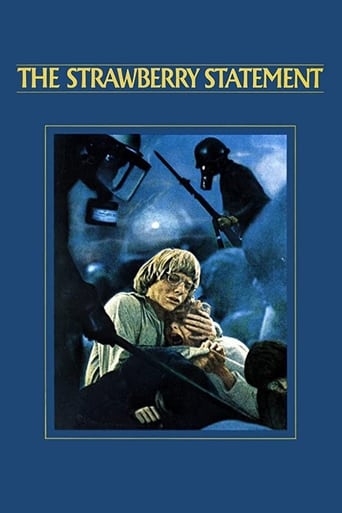
The Strawberry Statement (1970)
They're young and feel everything more deeply... and there's so much to feel deeply about.
A college student joins a group of revolutionaries to meet girls but ends up committed to their goals.
- Date of release
- 1970-08-28
- TMDB
- 5.9 / 10 (43)
- Runtime
- 1h 49m
- Genres
- Drama, Romance
- Director
- Stuart Hagmann
Casting
- Bruce Davison — Simon
- Kim Darby — Linda
- Bud Cort — Elliot
- Murray MacLeod — George
- Tom Foral — Coach
- Bob Balaban — Elliot
- Michael Margotta — Swatch
- Israel Horovitz — Dr. Benton
- James Kunen — Chairman
- Jeannie Berlin — Girl with Clipboard
- Carol Bagdasarian — Girl on Telephone
- Jon Hill — Student
Interesting facts
The Strawberry Statement is a 1970 American comedy-drama directed by Stuart Hagmann, loosely based on the non-fiction account that James Kunen wrote about the 1968 Columbia University protests. Set against the backdrop of 1960s counterculture, the film follows Simon, an initially apathetic college student at a fictional San Francisco university, as he becomes involved in campus demonstrations opposing the construction of a segregated gymnasium.
Production
Clay Felker, editor of New York magazine, introduced producer Irwin Winkler to a column by James Kunen, predicting it would become a book (published in 1969). After reading it, Winkler and his producing partner, Bob Chartoff, acquired the film rights. "We thought it could create understanding—the schism was so great between the generations then," Winkler recalled. "It was an important subject.
Winkler, having seen The Indian Wants the Bronx and It's Called the Sugar Plum by Israel Horovitz, approached the playwright about adapting the book. Horovitz pitched the film to MGM, proposing it be shot at Columbia University. "At the time, there was a student group that had shot a lot of black and white documentary footage of the strikes at Columbia," he explained.
The pitch was successful, and in May 1969, MGM announced plans to produce the film. At the time, MGM's president was "Bo" Polk, and Herb Solow served as head of production.
Horovitz was officially signed to write the screenplay, ultimately drafting ten versions over two years. François Truffaut was offered the director's role but declined. The project was eventually assigned to Stuart Hagmann, known for his work in television and advertising.
Horovitz faced challenges adapting the script when MGM suggested relocating the setting to the West Coast. He consulted Kunen for several days before questioning the film's core purpose: "Who is this movie really for? What's the point of it? If it’s just preaching to the already informed, then it will have no worth."
Read on Wikipedia · Text from Wikipedia, CC BY-SA 4.0. Data from Wikidata.
Recommended
- Fire with Fire 1986 · ★ 6.2
- Nine Lives 2005 · ★ 6.1
- Ashes in the Snow 2018 · ★ 6.3
- Time Is Up 2021 · ★ 6.5
- Maria's Lovers 1984 · ★ 6.0
- Two for the Seesaw 1962 · ★ 6.5
- Blind 2017 · ★ 6.1
- Newness 2017 · ★ 6.1
- See You Soon 2019 · ★ 5.9
- A Journal for Jordan 2021 · ★ 6.9
- Sylvie's Love 2020 · ★ 6.2
- Winter Spring Summer or Fall 2024 · ★ 7.3